
As an Amazon Associate, we earn from qualifying purchases. This post may contain affiliate links.
By Luis Gustavo. See how we research and review our content.
Few animals carry as much cultural weight as the tiger: present on flags, in religions, and in legends across much of Asia, it’s also, in practical terms, the largest living cat on the planet — bigger even than the lion. Behind the familiar image of orange-and-black stripes lies a predator with far more specific adaptations than most people realize, from its skin to its social behavior. These 6 facts gather some of the most interesting findings about this species.
1. A tiger’s stripes go all the way through its skin
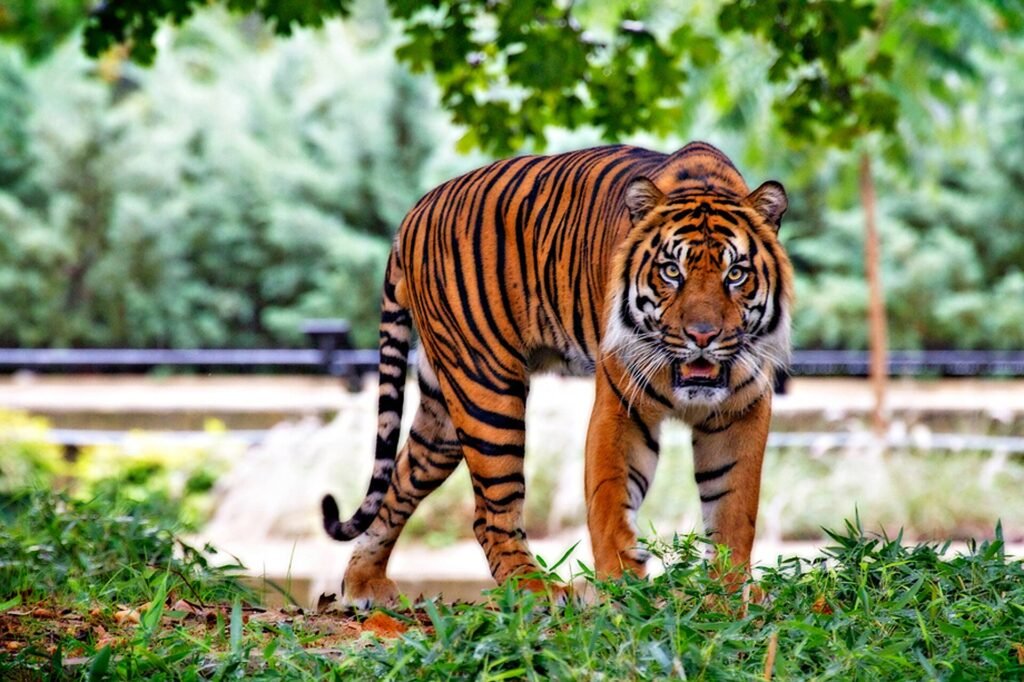
Contrary to what many people think, a tiger’s stripe pattern isn’t just a feature of its fur: the skin underneath is striped too, following the exact same pattern visible on the outside. That means if a tiger were shaved, its individual stripe pattern would still be recognizable on the skin itself. This pattern is unique to each animal, much like a fingerprint — no two tigers have exactly the same stripes, not even siblings from the same litter. Researchers and park rangers rely on this very feature to identify specific individuals in wild population monitoring projects, comparing photographs taken by camera traps over time.
2. The Siberian tiger is the largest cat in the world
Among the six tiger subspecies that still exist in the wild, the Siberian tiger (also called the Amur tiger) is the largest of all, with adult males sometimes exceeding 300 kilograms (660 pounds) and measuring more than 3 meters (10 feet) from nose to tail tip. This subspecies lives mainly in the far east of Russia, in cold forests that demand an extra layer of fat and denser fur than tigers from tropical regions, such as the Bengal tiger. For comparison, an adult male lion rarely exceeds 250 kilograms, which puts the tiger ahead as the largest living wild cat by average weight and length.
3. Tigers love water and are excellent swimmers
Unlike most domestic cats, which avoid water at all costs, tigers not only tolerate swimming but genuinely enjoy it — it’s common to see them cooling off in rivers and ponds during the hottest days, since they have relatively few sweat glands and rely on water to help regulate body temperature. They’re able to cross wide rivers by swimming, and have been recorded swimming distances of several kilometers between islands, especially in the Sundarbans mangroves on the border between India and Bangladesh. This ability also doubles as a hunting strategy: tigers often chase prey into water, where they have an advantage over animals less adapted to swimming.
4. Three tiger subspecies have already gone extinct
Of the nine tiger subspecies historically recognized, three disappeared completely during the 20th century: the Bali tiger, extinct in the 1940s; the Caspian tiger, extinct around the 1970s; and the Javan tiger, extinct in the 1980s. The six remaining subspecies — Bengal, Siberian, South China, Indochinese, Malayan, and Sumatran — are all still classified as endangered or critically endangered by the International Union for Conservation of Nature (IUCN), mainly due to habitat loss and illegal hunting. Conservation programs such as Project Tiger, launched by India in 1973, have helped stabilize and even grow local populations in some reserves, but the species as a whole still depends heavily on protected areas to survive.
5. A tiger’s roar can be heard for miles
A tiger’s roar is produced by a special structure in the larynx that allows it to generate very low-frequency sounds, partly inaudible to the human ear, but which travel much farther than high-pitched sounds — under favorable conditions, it can be heard up to roughly 3 kilometers (about 2 miles) away in the forest. Tigers use their roar mainly to mark territory and signal their presence to other tigers, since they’re solitary animals that avoid direct contact for most of their adult lives. Besides roaring, they communicate through scent marking (urine and secretions from glands spread across their territory) and through a behavior called “flehmen,” a distinctive grimace used to analyze scents left by other tigers.
6. Tigers see far better in the dark than humans do
Night vision is one of the tiger’s most important adaptations as a hunter, since most of its hunting happens at dusk or during the night. A tiger’s night vision is estimated to be roughly 5 to 6 times more sensitive to light than human vision, thanks to a reflective layer behind the retina called the tapetum lucidum — the same structure responsible for the characteristic glow of a cat’s eyes when lit up in the dark. That visual advantage, combined with sensory whiskers on the front legs that help the animal feel ground vibrations, lets a tiger approach prey in near-total silence before its final attack. Anyone who enjoys this kind of wildlife fact might also like our piece on facts about elephants.
How a tiger cub learns to hunt
A tigress carries her young for about 103 days, and a litter averages two to four cubs. Births in the wild usually come 20 to 24 months apart, because the cubs depend on their mother for a long time.
They stay with her until they can hunt successfully, usually at about 18 to 24 months old. Those early months are risky: in one study in Nepal’s Chitwan National Park, roughly a third of cubs, about 34 percent, died during their first year.
Adult tigers hunt about once a week, and a tiger can eat up to 75 pounds (34 kilograms) of meat in a single night. A mother with growing cubs therefore depends on a territory with plenty of prey, such as deer and wild boar.
Recommended products
Realistic Tiger Plush Toy — a fun way to keep the fascination with the world’s largest cat close by, with a finish that closely mirrors the real stripe pattern.
Big Cats of the World Photo Book — a coffee-table-style collection for anyone who wants to see tigers and other big cats up close beyond a single article.
Disclosure: this is our tracked affiliate link.