
As an Amazon Associate, we earn from qualifying purchases. This post may contain affiliate links.
By Luis Gustavo. See how we research and review our content.
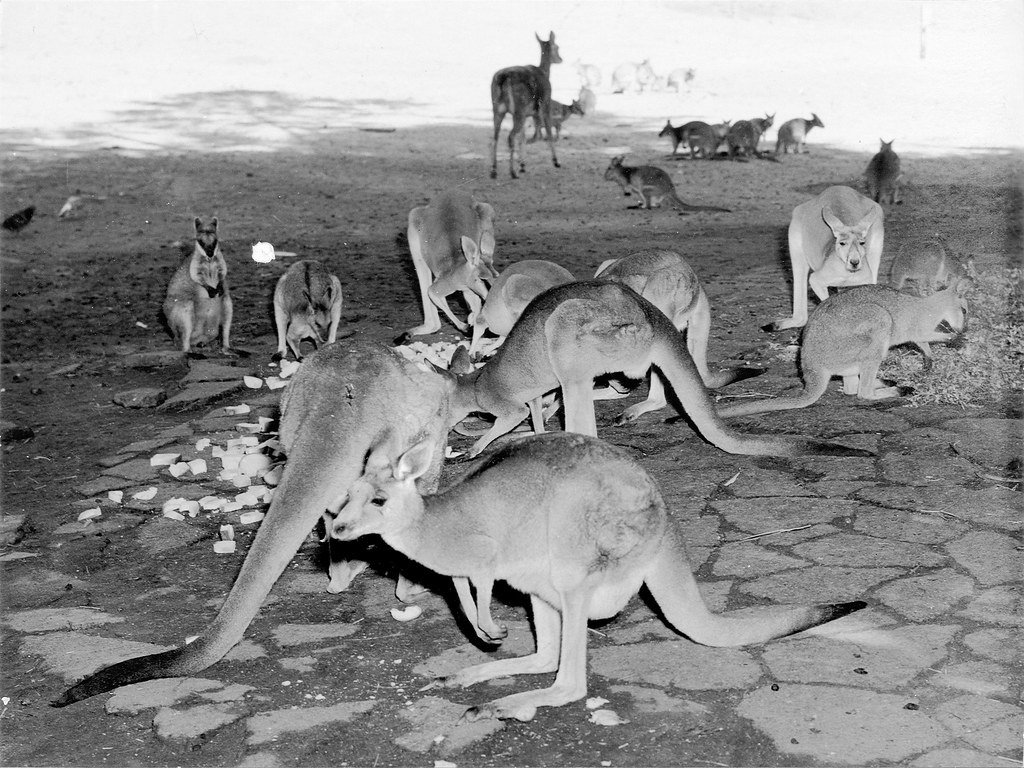
Australia’s national symbol, the kangaroo is one of the best-known marsupials in the world, but most of what makes it a genuinely interesting animal has little to do with the cartoonish “boxing, hopping critter” stereotype most people picture. From the way its joeys are born to the mechanics that let it leap several meters without burning extra energy, the kangaroo packs in adaptations that very few other mammals on the planet have developed. These 6 facts about kangaroos show why this animal is far more complex than it first appears.
1. Kangaroos can barely walk backward at all
Because of their large hind legs, built almost entirely for forward propulsion, and a muscular tail that works like a built-in fifth limb for support, kangaroos have an extremely hard time taking any step in reverse. This anatomical quirk is often cited as the symbolic reason the kangaroo appears on Australia’s coat of arms: the idea of a country that “only moves forward, never backward.” In practice, when moving slowly, a kangaroo uses a locomotion style called pentapedal walking, planting both front paws, both hind legs, and its tail on the ground almost like a fifth point of support, before switching back to a regular hop at higher speed.
2. Leg tendons work like built-in springs
Unlike most mammals, which burn more and more energy as their speed increases, kangaroos manage to keep their energy use nearly constant across a wide range of hopping speeds. That happens because the tendons in their hind legs store and release elastic energy with every hop, much like a spring being compressed and released over and over, cutting down the muscular effort needed to hop again. An adult red kangaroo, the largest marsupial species in the world, can reach speeds of roughly 70 km/h (43 mph) in short bursts, cover distances of up to 9 meters (about 30 feet) in a single leap, and clear obstacles up to 3 meters (10 feet) tall. That energy efficiency is especially useful in Australia’s arid interior, where red kangaroos often need to travel long distances in search of water and fresh vegetation without burning through energy reserves that matter a lot in such a dry environment.
3. Joeys are born about the size of a jellybean
A newborn kangaroo, called a joey, is born extremely underdeveloped, measuring just a couple of centimeters and weighing less than 1 gram — roughly the size of a jellybean or a lima bean. Even so, using only instinct and its front paws, the joey manages to crawl entirely on its own from the birth canal up into the mother’s pouch, where it latches onto a teat and continues developing for months. Depending on the species, a joey doesn’t fully stop depending on the pouch until around 12 months of age, even though it starts hopping out and back in well before that.
4. Males box each other over territory and mates
Adult male kangaroos, called “boomers,” often get into physical disputes that look a lot like boxing: they balance on their tail, rear up on their hind legs, and use their front paws to punch and shove an opponent, sometimes landing powerful kicks with their hind legs. These fights establish hierarchy within the group, known as a “mob,” and improve a male’s odds of mating, becoming more frequent and intense during the breeding season. Most of these clashes end without serious injury, functioning more as a show of strength than an actual fight to hurt the other kangaroo.
5. There are four main species, almost all found in Australia
The word “kangaroo” formally covers four main species: the red kangaroo (the largest, with males weighing over 90 kg/200 lbs), the eastern grey kangaroo, the western grey kangaroo, and the antilopine kangaroo, all found almost exclusively in Australia, with a small introduced population also living in New Zealand. That near-exclusive range is one of the reasons the kangaroo became such a strong symbol of the country, appearing on the national coat of arms and on Australian coins. In the wild, a red kangaroo can live between 20 and 23 years, a fairly long lifespan for a mid-sized mammal, and the species is currently listed as “least concern” by the International Union for Conservation of Nature, since its population stays stable even across harsh, arid regions.
6. Kangaroos can “pause” the pregnancy of a second joey
Female kangaroos have a rare reproductive adaptation called embryonic diapause: they can become pregnant with a second joey while still nursing the first one, but the development of that new embryo is temporarily put on hold inside the uterus until the pouch becomes free or conditions improve. That biological pause, combined with the ability to survive long dry stretches by getting much of the water they need directly from the vegetation they eat, helps explain how kangaroos manage to reproduce so efficiently even in the driest parts of Australia’s interior. Anyone interested in unique animal adaptations might also like our piece on facts about elephants and facts about penguins, two other animals with social and physical behaviors just as particular as a kangaroo’s.
Recommended products
Realistic Kangaroo Plush Toy — a gift or decorative pick for anyone who got hooked on this Australian marsupial’s facts.
Australian Wildlife Field Guide Book — a deeper dive into kangaroos and the rest of Australia’s unique wildlife for anyone who wants to go further than this article.
Disclosure: this is our tracked affiliate link.
Which of these kangaroo facts surprised you the most? Share this article with anyone else who loves animal facts.