
As an Amazon Associate, we earn from qualifying purchases. This post may contain affiliate links.
By Luis Gustavo. See how we research and review our content.
For nearly 76 years, Pluto was officially the Solar System’s ninth planet — until a vote by astronomers in 2006 changed its classification for good and sparked a debate that still hasn’t fully died down. But that status debate doesn’t make Pluto any less of a strange, fascinating world: it has a moon nearly its own size, an orbit that sometimes brings it closer to the Sun than Neptune, and it’s only been visited up close once in history. These 6 facts about Pluto show why this small icy world still fascinates scientists decades after it was first found.
1. Pluto was discovered by comparing photographs of the sky
Pluto was found on February 18, 1930, by American astronomer Clyde Tombaugh, then just 24 years old, working at Lowell Observatory in Arizona. Tombaugh used an instrument called a blink comparator, which rapidly switched between two photographs of the same patch of sky taken on different nights, making any object that had moved appear to “blink” between the two images while the fixed stars stayed in place. After months of examining thousands of pairs of photographic plates, Tombaugh spotted a tiny point shifting exactly the way a distant planet should — a search that had actually begun years earlier, driven by supposed irregularities in the orbits of Uranus and Neptune that later turned out to be calculation errors, not caused by Pluto at all.
2. Pluto was demoted to “dwarf planet” in 2006
After decades of being called the ninth planet, Pluto lost that status on August 24, 2006, following a vote by the International Astronomical Union (IAU) in Prague. The reason wasn’t anything that changed about Pluto itself, but the discovery of other similar objects in the same icy region of the Solar System, such as Eris, which at the time appeared to be a comparable size or even larger. The IAU then created a new category, “dwarf planet,” defined as a body that orbits the Sun, is rounded by its own gravity, but hasn’t “cleared” its orbital neighborhood of other smaller objects — exactly the criterion Pluto fails, since it shares its region of space with countless other bodies in the Kuiper Belt.
3. Its largest moon is so big the two orbit each other
Pluto has five known moons, but the largest, Charon, is so big relative to the dwarf planet (a little over half of Pluto’s diameter) that astronomers describe the pair as a “double system”: the center of mass they both orbit sits outside Pluto’s surface, in the empty space between the two bodies, rather than inside Pluto the way it does between Earth and the Moon. On top of that, Pluto and Charon are mutually tidally locked — each one always shows the same face to the other, so that from the side of Pluto facing Charon, the moon never rises or sets, staying fixed at the exact same point in the sky at all times.
4. New Horizons visited Pluto up close just once, in 2015
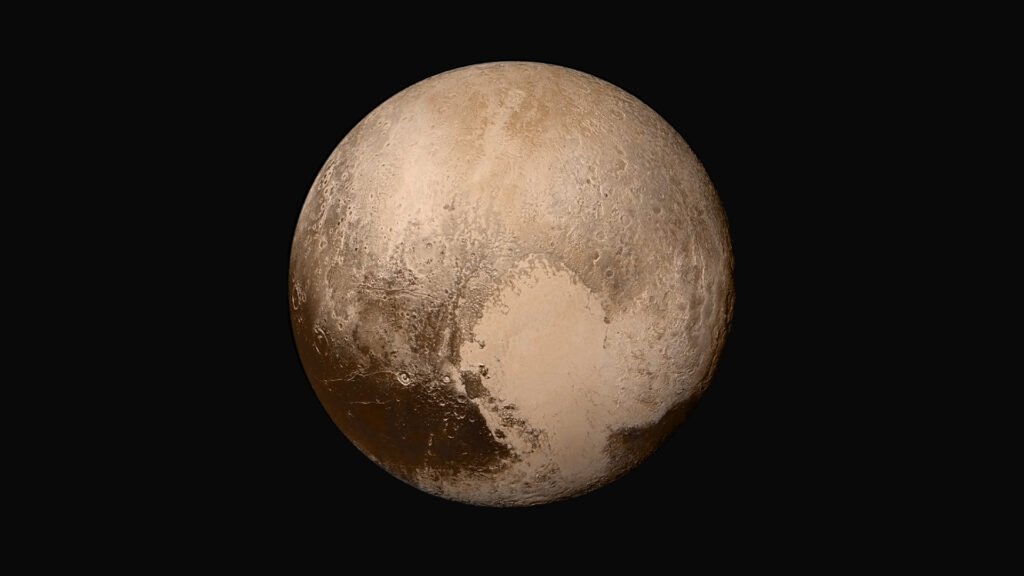
After a journey of more than nine years, NASA’s New Horizons spacecraft flew past Pluto on July 14, 2015, in the first and, to this day, only close-up visit to this distant world. The images revealed a heart-shaped region named Tombaugh Regio, after the dwarf planet’s discoverer, which includes a vast nitrogen-ice plain called Sputnik Planitia with no visible craters — a sign that the surface is geologically young and still active. The spacecraft also found water-ice mountains rising up to 11,000 feet (3,500 meters), comparable to the Rocky Mountains, along with evidence suggesting a subsurface ocean of liquid water may exist beneath that frozen layer.
5. Pluto’s orbit is tilted enough that it’s been closer to the Sun than Neptune
Unlike the traditional planets, whose orbits are nearly circular and aligned to roughly the same plane, Pluto’s path around the Sun is fairly elongated and tilted about 17 degrees relative to the orbital plane of the other planets. That elongation means that, for part of its long 248-Earth-year orbit, Pluto actually ends up closer to the Sun than Neptune — which really did happen between 1979 and 1999. Despite that apparent overlap, the two bodies never risk colliding, because they sit in a stable 3:2 orbital resonance: for every two trips Pluto makes around the Sun, Neptune completes exactly three, a gravitational balance that keeps them apart during those crossings.
6. Pluto’s atmosphere freezes and rebuilds itself over the course of its year
Pluto has an extremely thin atmosphere, made mostly of nitrogen with traces of methane and carbon monoxide, that behaves in a way unique among Solar System bodies: as Pluto moves away from the Sun along its long orbit, the temperature plunges and much of that gas condenses directly onto the frozen surface, causing the atmosphere to shrink dramatically. When Pluto swings back closer to the Sun, that heat sublimates the ice back into gas, rebuilding the atmosphere all over again — a full cycle that repeats across each 248-Earth-year orbit around the Sun. Readers who enjoy this kind of trivia about the edge of the Solar System might also like our articles on facts about Neptune and facts about Uranus, two of Pluto’s icy neighbors in the outer Solar System.
Recommended products
Educational Solar System Poster with Pluto — a visual way to keep track of Pluto and the rest of the planets, great for a study space or office wall.
3D Pluto Planet Night Light Lamp — a fun decorative reminder of this small, icy world for any bedroom or desk.
Disclosure: this is our tracked affiliate link.
Which of these Pluto facts surprised you the most? Share this article with anyone else who loves astronomy.