
As an Amazon Associate, we earn from qualifying purchases. This post may contain affiliate links.
By Luis Gustavo. See how we research and review our content.
With adult males reaching more than 5 meters tall, the giraffe is the tallest living land animal on the planet — and also one of the most misunderstood, despite being a constant presence in zoos and nature documentaries. Behind that long neck and distinctive coat pattern lies a set of physiological and behavioral adaptations that most people never hear about, from how its heart works to surprisingly short sleep habits. These 6 facts cover some of the most impressive traits of this towering animal.
1. A giraffe’s neck has the same number of vertebrae as a human neck
Despite measuring up to 2 meters long, a giraffe’s neck is made up of just 7 cervical vertebrae — exactly the same number found in a human neck. The difference is size: each of a giraffe’s vertebrae can measure more than 25 centimeters long, while human vertebrae are far smaller. That elongated structure requires specific adaptations throughout the animal’s entire cardiovascular system to pump blood all the way up to its head, which sits at a considerable height above its heart.
2. A giraffe’s heart is one of the most powerful in the animal kingdom
To push blood up such a long neck against gravity, an adult giraffe’s heart can weigh around 11 kg and generate blood pressure roughly twice as high as that of a healthy human. That system also relies on a network of special valves in the neck’s blood vessels, which keep blood from rushing too quickly into the animal’s head the moment it lowers its neck to drink water — without that mechanism, the sudden pressure change could cause fainting or damage to the brain’s blood vessels.
3. Every giraffe has a completely unique spot pattern
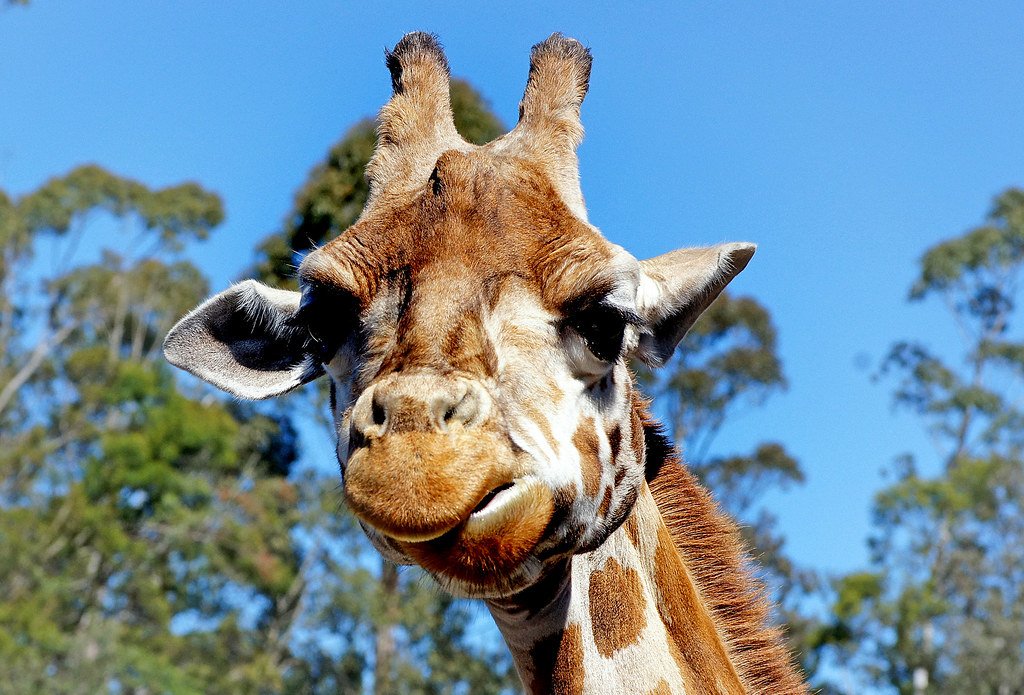
Much like human fingerprints, the pattern of spots on a giraffe’s coat is individual and never repeats on any other animal of the species, even among calves born to the same mother. Researchers studying wild giraffe populations often use that exact spot pattern to identify and track specific individuals over the years, with no need for any kind of artificial tagging. The spot pattern is also thought to play a role in camouflage among savanna vegetation and, possibly, in regulating body temperature, since each spot has its own dense network of blood vessels underneath.
4. Giraffes sleep very little — sometimes less than an hour a day
Among land mammals, the giraffe is among the ones that sleep the least total time per day, often getting less than two hours of sleep split across several short stretches that can last just a few minutes each. These sleep periods usually happen while standing or in a resting position with the neck folded back over the body, since lying down for long periods leaves the animal far more vulnerable to predators out in the open savanna. That fragmented, brief sleep pattern is one of the behavioral adaptations that help the species survive in environments with a constant presence of lions and other large predators.
5. A giraffe’s tongue can measure up to 45 centimeters and is a dark color for a specific reason
A giraffe’s tongue can reach about 45 centimeters long, an essential tool for wrapping around and pulling acacia leaves out from between the dense thorns of those trees without hurting the animal’s mouth. The part of the tongue that stays most exposed to the sun while feeding has a bluish or dark purple color, a trait researchers associate with protection against sunburn, since that section stays outside the mouth for long stretches every day while the animal feeds. Besides the long tongue, giraffes also have thick saliva and tough, flexible lips that help them handle thorny branches without getting cut, which lets the animal spend much of the day — in some cases more than 16 hours — almost constantly feeding, since acacia leaves are low in calories and require a large daily volume to meet the animal’s energy needs.
6. Recent genetic research suggests there may be more than one giraffe species
For a long time, all giraffes were treated as a single species with different regional subspecies. Genetic studies published starting in 2016, however, found differences in DNA between populations from different regions of Africa large enough that some researchers now argue there are four distinct giraffe species rather than just one — a reclassification that’s still debated among specialists and that has a direct impact on conservation strategy, since smaller, genetically distinct populations may be more vulnerable to extinction than previously thought. The International Union for Conservation of Nature (IUCN) already classifies the giraffe as a vulnerable species, reflecting a sharp decline in the total wild population over recent decades — estimates point to a drop of nearly 40% in the number of wild giraffes across Africa between the late 1980s and the 2020s, driven mainly by habitat loss, the fragmentation of savanna land from agricultural expansion, and, to a lesser extent, illegal hunting. That combination of a recent genetic discovery alongside an accelerating population decline is one of the reasons researchers and conservation groups have paid closer attention to the species in recent years, after decades of treating giraffes as relatively safe simply because they’re large, visible animals. Anyone who enjoys this kind of fact might also like our piece on facts about elephants and facts about wolves, two other animals with fascinating social behavior.
Recommended products
Compact Wildlife Viewing Binoculars — handy for spotting tall animals like giraffes from a distance on safaris, open-range zoos, or nature reserves.
African Wildlife Field Guide — a useful reference for identifying giraffes and other savanna species while traveling or birdwatching.
Disclosure: this is our tracked affiliate link.
Which of these giraffe facts surprised you the most? Share this article with anyone else who loves wildlife.