
As an Amazon Associate, we earn from qualifying purchases. This post may contain affiliate links.
By Luis Gustavo. See how we research and review our content.
The Moon is up there every night, and most people barely give it a second glance. But behind that grey ball in the sky is a story most of us never learned in school. Here are 5 facts that might just change the way you look at it.
1. You’ve never seen the “dark side” of the Moon
The Moon’s rotation is tidally locked with Earth: it spins on its own axis in exactly the same time it takes to orbit us. The result: we only ever see one face. The “far side” wasn’t actually photographed until 1959, by a Soviet probe — and no, it isn’t “dark” in the sense of no light, it’s just hidden from our view.
2. The Moon is drifting away from Earth
Every year, the Moon moves about 3.8 cm farther from Earth — roughly the speed your fingernails grow. Billions of years from now, it will be far enough away that total solar eclipses will no longer be possible.
3. It’s responsible for tides (and your slightly longer days)
The Moon’s gravity pulls on the oceans, creating tides. But a lesser-known side effect: that gravitational drag is slowing Earth’s rotation, making our days about 1.7 milliseconds longer every century.
4. Those “dark spots” have names
What looks like dark blotches to the naked eye are actually ancient solidified lava plains — called “lunar maria” (like Mare Tranquillitatis, where Apollo 11 landed). With a basic telescope, you can clearly tell these regions apart from the brighter, mountainous highlands.
5. You can see craters from your own backyard
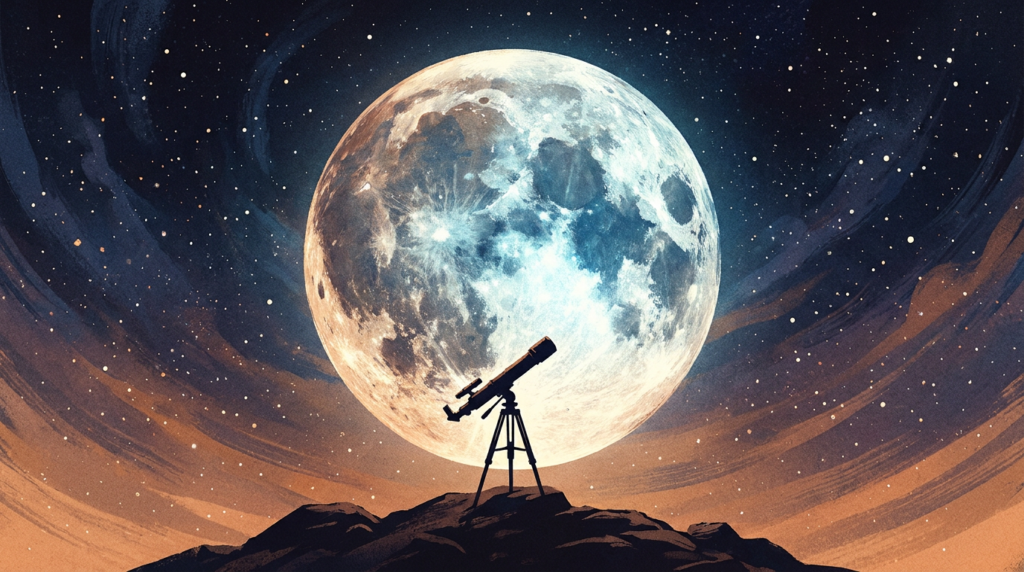
You don’t need a professional observatory. With an entry-level amateur telescope, you can already spot craters, mountains, and lunar maria in surprising detail — especially near the Full Moon or Waxing Gibbous phase, when raking light casts shadows that bring out the terrain.
If this topic interests you, it’s worth checking out our piece on international space station and on artemis mission.
Want to see it for yourself?
If you enjoyed these facts, the obvious next step is pointing a telescope at the sky. For beginners, we recommend:
Gskyer Telescope, 70mm Aperture Astronomical Refracting Telescope — great value for Moon-watching and a solid entry point into amateur astronomy, tripod included.
Disclosure: this is our tracked Amazon affiliate link.
Enjoyed this? Share it with someone who also needs to put the phone down and look up tonight.