
As an Amazon Associate, we earn from qualifying purchases. This post may contain affiliate links.
By Luis Gustavo. See how we research and review our content.
Neptune, the eighth and final planet in the Solar System, sits so far from the Sun that sunlight takes more than four hours to reach it — compared to just over eight minutes for Earth. Despite that extreme distance and the tiny fraction of solar energy it receives, Neptune is home to the fastest winds ever recorded on any planet, and its very existence was confirmed through mathematics before anyone ever saw it directly. These 6 facts about Neptune show why this deep-blue ice giant still fascinates astronomers almost two centuries after it was found.
1. Neptune was discovered by math before it was ever seen
Unlike every other planet, Neptune wasn’t spotted by an astronomer scanning the sky by chance. In the early 1800s, scientists noticed that Uranus’s orbit had small irregularities that didn’t match the predictions of Newtonian gravity — unless another, still-unknown planet was tugging on it gravitationally. French mathematician Urbain Le Verrier calculated the likely position of this “invisible” planet based purely on those orbital perturbations and sent his coordinates to astronomer Johann Galle at the Berlin Observatory. On the night of September 23, 1846, Galle pointed his telescope exactly where Le Verrier predicted — and found Neptune within about 1 degree of that position, one of the greatest triumphs of mathematical physics in history.
2. Neptune has the fastest winds in the Solar System
Even though it’s so far from the Sun that it receives almost no energy to power its atmosphere, Neptune holds the record for the fastest winds ever measured on any planet: gusts reaching roughly 1,300 miles per hour (2,100 km/h), measured by the Voyager 2 spacecraft in 1989. For comparison, Earth’s strongest hurricanes rarely exceed 200 mph. Scientists still debate exactly where that energy comes from — one leading idea is that the planet’s own residual internal heat, combined with the lack of friction against a solid surface, lets these wind currents circulate through the gaseous atmosphere with almost no loss of speed.
3. Neptune has only been visited up close once
In the entire history of space exploration, only one spacecraft has ever come near Neptune: NASA’s Voyager 2, during a brief flyby on August 25, 1989, the final major milestone of its grand tour through the outer Solar System. That flyby revealed unprecedented details about Neptune’s atmosphere, its faint rings, and its moons, but more than 35 years later no other mission has returned to study it up close. Space agencies have discussed proposals for a dedicated orbiter mission to Neptune and Uranus, but none has been approved and launched so far — making Neptune, alongside Uranus, one of the least directly explored places in the Solar System.
4. The Great Dark Spot appeared and then vanished
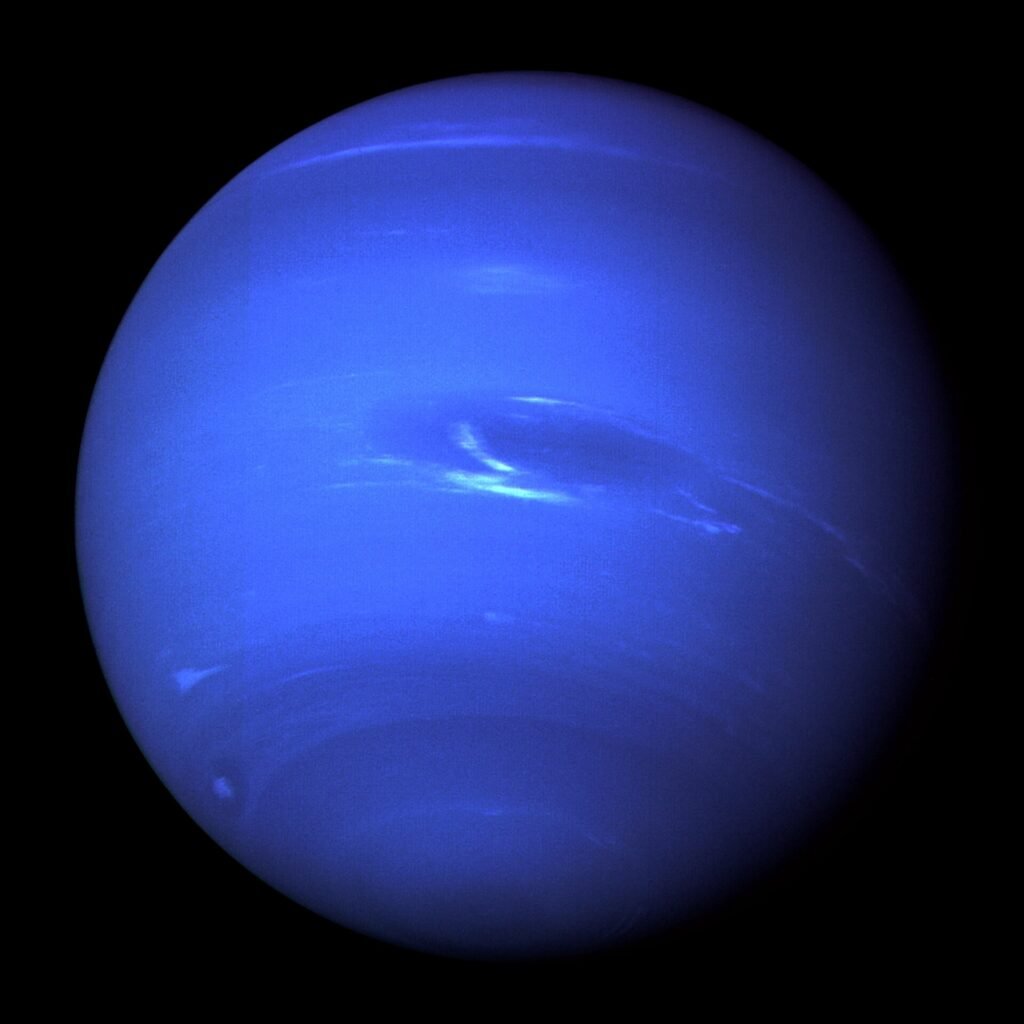
During the 1989 flyby, Voyager 2 photographed a massive dark storm in Neptune’s atmosphere, named the Great Dark Spot in direct comparison to Jupiter’s famous Great Red Spot. The difference is that when the Hubble Space Telescope observed Neptune again in 1994, the spot was simply gone. Since then, astronomers have recorded several other smaller dark spots appearing and disappearing over the course of just a few years, suggesting that storms in Neptune’s atmosphere are far more unstable and short-lived than Jupiter’s Great Red Spot, which has lasted for centuries at minimum.
5. A single orbit around the Sun takes 165 Earth years
Neptune sits so far from the Sun — roughly 2.8 billion miles (4.5 billion km) away — that it takes about 165 Earth years to complete a single orbit. That means Neptune only finished its first full orbit since its 1846 discovery in the year 2011, when it “closed the loop” almost exactly at the same point in the sky where Le Verrier and Galle first located it. No one alive at the time of Neptune’s discovery ever lived to see the planet complete a full trip around the Sun.
6. Triton, the moon that orbits backward
Neptune’s largest moon, Triton, has an extremely rare orbital quirk: it travels in the opposite direction to Neptune’s own rotation, a pattern called a retrograde orbit that no other large moon in the Solar System shares. That’s strong evidence Triton didn’t form alongside Neptune at all, but was instead captured by the planet’s gravity after originating in the distant Kuiper Belt, the same icy region Pluto comes from. Voyager 2 also recorded geysers of frozen nitrogen erupting from Triton’s surface, proof of active geology on an extremely cold moon. Deep inside Neptune itself, scientists have proposed that the extreme pressure on methane in the lower atmosphere could compress carbon atoms into diamond crystals, in a theoretical “diamond rain” that hasn’t been observed directly, only suggested by computer models and lab experiments at matching pressures. Readers who enjoy this kind of space trivia might also like our articles on facts about Uranus and facts about Jupiter, the Solar System’s other gas and ice giants.
Recommended products
3D Neptune Planet Lamp (16 Colors, Night Light Decor) — a decorative way to keep this piece of space trivia close by, in a bedroom, office, or study.
Glow-in-the-Dark Solar System Wall Stickers — a fun, low-effort way to map out Neptune and the rest of the planets on any wall or ceiling.
Disclosure: this is our tracked affiliate link.
Which of these Neptune facts surprised you the most? Share this article with anyone else who loves astronomy.