
As an Amazon Associate, we earn from qualifying purchases. This post may contain affiliate links.
By Luis Gustavo. See how we research and review our content.
On August 12, 2026, the sky went dark in the middle of the day over Greenland, Iceland, and parts of Spain — the only total solar eclipse of 2026, and one of the year’s most talked-about astronomical events. Whether you missed it or watched it and want to understand what you actually saw, this guide is built to be a genuine reference: how a total solar eclipse mechanically happens, why it doesn’t occur every new moon, what totality actually looks and feels like, how eye safety really works, and — most importantly — when and where the next solar eclipse will happen, including the big one on August 2, 2027, with nearly six and a half minutes of totality. Bookmark this page; it’s written to be revisited any time the question “when is the next solar eclipse” comes up again.
The Mechanics Behind a Total Solar Eclipse
A solar eclipse occurs when the Moon passes directly between the Sun and Earth, blocking some or all of the sunlight that would otherwise reach us. Because the Moon is about 400 times smaller than the Sun but also about 400 times closer to Earth, the two bodies appear almost exactly the same size in our sky — a cosmic coincidence that makes a total solar eclipse possible in the first place, with the lunar disk fully covering the solar disk. This alignment can only happen at a new moon, when the Moon sits between the Sun and Earth. The shadow the Moon casts on Earth’s surface is what produces the eclipse, and the shape and path of that shadow governs everything about where and how the event is visible.
Why We Don’t Get an Eclipse Every New Moon
If a new moon happens every month, why are solar eclipses so rare? The answer lies in the tilt of the Moon’s orbit: the plane in which the Moon orbits Earth is inclined about 5 degrees relative to the plane in which Earth orbits the Sun. At most new moons, the Moon passes slightly above or below the straight line connecting the Sun and Earth, so its shadow simply misses the planet. A solar eclipse only happens when a new moon coincides with the Moon crossing that orbital plane — something that occurs only two to five times a year anywhere on Earth. A *total* solar eclipse visible from any single point on the planet is rarer still, happening on average only about once every 18 months somewhere in the world.
Total, Partial, Annular, or Hybrid: What’s the Difference
Not every solar eclipse looks the same. In a total eclipse, the Moon completely covers the Sun’s disk, but that’s only visible within a narrow band called the path of totality, typically 100 to 200 kilometers wide. Outside that band, but still across a much wider region, the eclipse appears partial, with the Moon covering only a slice of the Sun. An annular eclipse happens when the Moon is farther from Earth in its elliptical orbit and appears too small to fully cover the Sun, leaving a visible ring of sunlight around it — the so-called “ring of fire.” Finally, a hybrid eclipse is the rarest type of all: it starts as annular along part of its path and shifts to total along another part, depending on the curvature of the Earth relative to the Moon’s shadow.
How Eye Safety Works During an Eclipse
Looking directly at the Sun, even when it’s mostly covered by the Moon, can cause permanent retinal damage within seconds, because concentrated solar radiation burns the tissue before the eye registers enough pain to react. The only exception is the brief window of totality during a total solar eclipse, when the Sun’s disk is 100% blocked and it’s genuinely safe to look with the naked eye — the instant any sliver of sunlight reappears, protective glasses need to go back on immediately. For every other phase of the event, ISO 12312-2 certified eclipse glasses are essential; they filter out more than 99.99% of visible light and block ultraviolet and infrared radiation, while ordinary sunglasses, no matter how dark, offer no protection at all. If you’re planning ahead for the next solar eclipse, it’s worth setting aside a certified pair well in advance, since demand — and stock — tends to vanish in the days leading up to the event.
What Totality Actually Looks and Feels Like
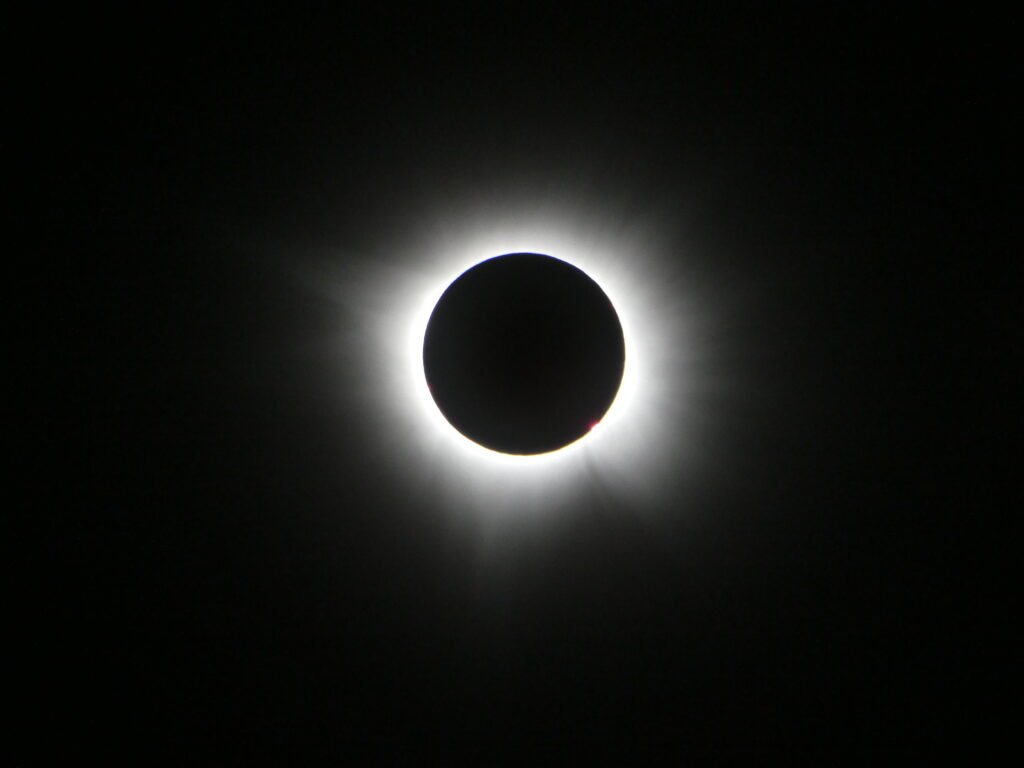
Anyone who’s witnessed a total solar eclipse describes it as something visceral, far beyond “the sky getting dark for a few minutes.” In the final moments before totality, an effect called Baily’s beads appears — small points of sunlight streaming through the valleys and mountains along the Moon’s edge — followed by the “diamond ring” effect, where a single bright point of light lingers just before everything goes dark. During totality itself, air temperature can drop anywhere from 3°C to 10°C (roughly 5°F to 18°F) within minutes, the horizon glows with a 360-degree twilight, stars and planets become visible in the middle of the day, and the solar corona — the Sun’s outer atmosphere, normally washed out by the disk’s brightness — appears as a pale silvery halo around the Moon’s dark silhouette. Animals notice too: birds go quiet, nocturnal creatures start stirring, and insects shift their behavior, all documented repeatedly by observers around the world.
The August 12, 2026 Eclipse That Already Happened
The total solar eclipse of August 12, 2026 was the only one of the year, with its path of totality crossing Greenland, Iceland, and northern Spain — Spain offered some of the best viewing conditions anywhere in Europe, with major cities and tourist regions falling inside or near the path of totality. That drew large crowds of eclipse chasers, or umbraphiles, into the country. Outside the narrow totality band, the eclipse was visible as a partial eclipse across much of Europe, northern Africa, and eastern North America. Events like this are a good reminder of why location and planning matter so much: a difference of just a few kilometers can mean the difference between witnessing full totality and only ever seeing a partial eclipse.
The Next Solar Eclipse: August 2, 2027
The next total solar eclipse is set for August 2, 2027, and it’s shaping up to be one of the most anticipated astronomical events of the century. Its path of totality will cross southern Spain, North Africa (Morocco, Algeria, Tunisia, Libya, and Egypt), and continue on through Saudi Arabia and Yemen. What makes this solar eclipse 2027 especially remarkable is the duration of totality — up to 6 minutes and 23 seconds at some points along the path, nearly three times longer than the 2026 eclipse, making it one of the longest total solar eclipses recorded this century. Cities like Luxor, Egypt, sitting near major archaeological sites, are already on the radar of eclipse-focused tour operators, and lodging along the entire path of totality is expected to book up well in advance.
How Eclipse Chasers Plan Their Trips
There’s a whole international community of enthusiasts known as umbraphiles (“shadow lovers”) who build entire trips around a few minutes of totality. Typical planning involves picking a spot within the path of totality with the longest possible duration, checking historical cloud-cover data for that date and region (since even light cloud cover can ruin the view of totality), and always keeping a backup travel plan in case the weather forecast shifts at the last minute. Many umbraphiles rack up dozens of total eclipses over a lifetime, crossing continents specifically to chase them, and it’s common to see the same group of observers reuniting in a different country for each event. Solar filters for cameras and telescopes, a spare pair of ISO 12312-2 glasses, and an updated eclipse path map are all standard gear for anyone taking eclipse chasing seriously.
Other Total Eclipses Through 2045: The Long-Term Calendar
After 2027, the calendar of total eclipses stays busy. Starting in 2028, Australia will experience a rare string of four total solar eclipses within a decade, all passing through major Australian cities — a genuine treat for anyone living in or planning a visit to Oceania during that stretch. For those in the United States, the next total eclipse to cross the continental US will be on March 30, 2033, with a path concentrated mostly over Alaska and areas near Russia, and totality lasting about 2 minutes 37 seconds. But the real headline event for American eclipse chasers doesn’t arrive until August 12, 2045, when a total eclipse will sweep coast to coast across the country, crossing California, Nevada, Utah, Colorado, Kansas, Oklahoma, Arkansas, Mississippi, Alabama, and Florida — a path experts already describe as one of the most spectacular ever mapped for North America.
Why Astronomers Still Rely on Eclipses to Study the Sun
Despite decades of advances in space technology, total solar eclipses remain genuinely valuable scientific tools. The solar corona, the Sun’s outermost atmospheric layer, can only be directly observed from Earth’s surface during the brief minutes of totality, because at any other time the brightness of the solar disk completely washes it out. Organizations like NASA (through science.nasa.gov/eclipses) and the National Solar Observatory (NSO) coordinate scientific observations during every total eclipse, gathering data on the corona’s temperature, magnetic field, and behavior — research that helps scientists better understand phenomena like coronal mass ejections, which can affect satellites and power grids back on Earth. It’s one of the reasons research teams travel to the same remote locations as eclipse tourists, setting up precision instruments in the minutes before totality begins.
Why Eclipses Fascinated and Frightened Ancient Civilizations
Before there was any astronomical explanation for it, a total solar eclipse was, for many ancient civilizations, a genuinely terrifying event: daylight turning to night without warning. Historical records show that peoples like the Babylonians were already able to predict eclipses with reasonable accuracy by tracking repeating patterns in the sky, but for most ordinary people the phenomenon was read as a bad omen, a battle between gods, or even a sign the world was ending. Different cultures developed their own mythologies to explain the Sun suddenly going dark, from creatures devouring the Sun to celestial battles, and traces of those beliefs still show up in folklore tied to the Moon and Sun today. If that angle interests you, it’s worth pairing this with our piece on facts about the Moon, since it’s the Moon’s own orbit that makes every solar eclipse possible in the first place.
How to Photograph a Solar Eclipse Without Ruining Your Gear
Photographing a solar eclipse requires the same caution as protecting your own eyes: pointing a camera or phone straight at the Sun without the right filter can fry a sensor in seconds, the same way it would damage a retina. Experienced eclipse photographers use dedicated solar filters for their lenses, usually made from the same material as ISO 12312-2 glasses, attached to the front of the lens throughout the partial phases — and removed only during the brief minutes of totality, when it’s safe to photograph the corona without a filter. Sturdy tripods, remote shutter releases to avoid camera shake, and pre-tested exposure settings are all standard practice, since the light changes dramatically within seconds as totality begins and ends. For anyone without specialized gear, the common advice is simple: just experience totality with your own eyes. Many seasoned eclipse watchers deliberately set the camera aside and live the moment, leaving the professional footage to the teams that follow every total eclipse.
The Economic and Tourism Impact of a Total Eclipse
Towns and regions that fall inside the path of totality typically see a major surge in tourism in the days leading up to a total solar eclipse. Lodging along the 2027 path of totality, for instance, is already seeing strong demand more than a year out, a pattern seen ahead of nearly every total eclipse in recent decades. Specialized “astrotourism” operators build full travel packages around the event, including transportation to strategic viewing points within the path of totality and last-minute contingency plans if the forecast shows clouds over the chosen spot. That surge also benefits local businesses, restaurants, and tour guides, making a total solar eclipse a genuine economic event in its own right, not just an isolated scientific occurrence.
Frequently Asked Questions About Solar Eclipses
Can I watch a solar eclipse without special glasses?
No, except during the brief minutes of totality in a total solar eclipse, when the Sun is 100% blocked. At every other stage — including partial and annular eclipses — ISO 12312-2 certified glasses are required to avoid permanent retinal damage.
How long does totality last during a solar eclipse?
It varies a lot by event: the August 2026 eclipse had a shorter totality window, while the solar eclipse 2027 will last up to 6 minutes and 23 seconds at some points along its path, making it one of the longest of the century.
When is the next solar eclipse visible in the US?
Neither the 2026 nor the 2027 total eclipse crosses the continental United States. The next one to do so is March 30, 2033 (mostly over Alaska), with the next true coast-to-coast US total eclipse not arriving until August 12, 2045.
How can I safely watch a solar eclipse without traveling to the path of totality?
Outside the path of totality, you can still watch a partial eclipse safely with ISO 12312-2 certified glasses, or follow live coverage from NASA and partner observatories, which typically stream the event in real time using specialized telescope footage.
Does a solar eclipse happen every year?
Yes, but not every eclipse is total. On average, two to five solar eclipses occur worldwide each year, split between partial, annular, and total — but a total eclipse visible from any one specific spot on Earth is much rarer.
Getting Ready for the Next Solar Eclipse
If you’re planning to catch the solar eclipse 2027 or any future event, the first thing on the list is certified protective glasses — without them, there’s no safe way to approach totality up close. A good pair of ISO 12312-2 glasses is inexpensive, lasts through several future eclipses, and makes the difference between experiencing the event firsthand and being stuck watching someone else’s photos and videos afterward.
Disclosure: this is our tracked affiliate link.
ISO 12312-2 Certified Solar Eclipse Glasses — see options on Amazon
Worth Marking on Your Calendar
Between the eclipse that already came and went in August 2026 and the nearly six-and-a-half-minute spectacle coming in August 2027, the next few years look set to be generous for anyone who likes looking up. If this guide helped you understand how a solar eclipse really works, let us know in the comments whether you’ve witnessed one before, or if you’re already planning your first trip chasing the Moon’s shadow — and share this with anyone else keeping an eye on the next solar eclipse.
If this topic interests you, it’s worth checking out our piece on facts about mars.