
As an Amazon Associate, we earn from qualifying purchases. This post may contain affiliate links.
By Luis Gustavo. See how we research and review our content.
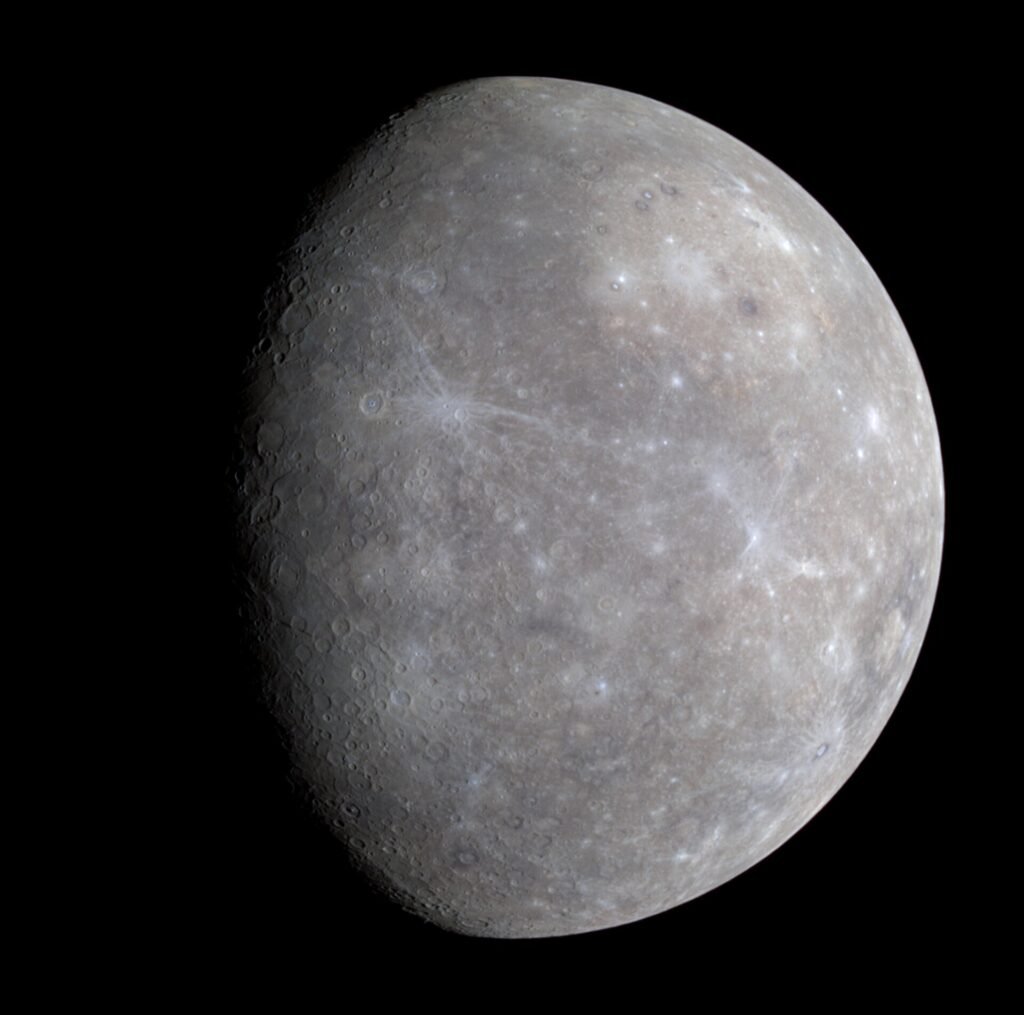
The smallest planet in the solar system and the closest to the Sun, Mercury is a world of extremes that rarely gets the attention of flashier neighbors like Mars and Jupiter. With no meaningful atmosphere to soften conditions on its surface, no moon of its own, and a day that lasts longer than its own year, Mercury packs in a set of traits that defy intuition about what it would be like to simply orbit so close to a star. These 6 facts cover what’s actually known about this small but endlessly quirky planet.
1. Mercury is smaller than two moons that orbit other planets
At roughly 4,879 km across, Mercury has been the smallest planet in the solar system since Pluto was reclassified as a dwarf planet in 2006 — and it’s actually smaller in diameter than Ganymede (Jupiter’s largest moon) and Titan (Saturn’s largest moon), both of which are bigger than Mercury itself. Despite its small size, Mercury isn’t lightweight: its density is nearly equal to Earth’s, the second-highest among the solar system’s planets, the result of a metallic core that’s disproportionately large for the planet’s overall size.
2. Its iron core takes up most of the planet
Mercury’s core is estimated to make up about 85% of the planet’s radius, the largest proportion of metallic core of any planet in the solar system — on Earth, by comparison, the core takes up less than half of the total radius. That oversized core is also why Mercury has a global magnetic field, though a much weaker one than Earth’s: the Mariner 10 spacecraft first detected it in the 1970s, a surprise to scientists at the time, who hadn’t expected meaningful magnetism from such a small, slowly rotating planet.
3. A day on Mercury lasts longer than a year on Mercury
Mercury rotates on its axis extremely slowly, locked in a rare 3:2 spin-orbit resonance — the planet completes exactly three rotations for every two trips around the Sun. In practice, that means a full solar day (from one sunrise to the next) lasts about 176 Earth days, while a complete orbit around the Sun (a “year” on Mercury) takes only 88 Earth days. In other words, a single day on Mercury lasts more than twice as long as a Mercury year — a combination that doesn’t repeat on any other planet in the solar system.
4. Mercury has the widest temperature swing of any planet
With no thick atmosphere to trap heat or spread it across the surface, Mercury faces extreme swings between day and night: the sunlit side can reach around 430°C, while the night side plunges to near -180°C. That difference of more than 600°C between day and night is the largest recorded on any planet in the solar system. Oddly enough, even Mercury’s polar craters — which never receive direct sunlight because of the planet’s almost nonexistent axial tilt — hold water ice in permanent shadow, confirmed by radar data and later by the MESSENGER spacecraft. That combination of a scorching dayside and a frozen, shadowed pole within the same small planet is one of the clearest examples of how little an atmosphere can change a world’s climate from one hemisphere, or even one crater, to the next.
5. Despite being closest to the Sun, Mercury isn’t the hottest planet
Contrary to what intuition suggests, Mercury doesn’t hold the title of hottest planet in the solar system — that record belongs to Venus, the second planet from the Sun. The explanation lies in the atmosphere: Mercury has essentially no atmosphere to trap heat, so its surface cools rapidly as soon as direct sunlight disappears. Venus, on the other hand, has an extremely dense carbon dioxide atmosphere that produces an extreme greenhouse effect, keeping its surface consistently hot both day and night at temperatures higher than Mercury’s.
6. Mercury wasn’t photographed up close until decades after other planets
NASA’s Mariner 10 was the first spacecraft to visit Mercury, making three flybys between 1974 and 1975 and photographing only about 45% of the planet’s surface due to the orbital geometry chosen for the mission. It wasn’t until 2011 that NASA’s MESSENGER spacecraft entered permanent orbit around Mercury, mapping the planet in full before deliberately crashing into its surface in 2015 at the end of the mission. Right now, the joint European and Japanese BepiColombo mission, launched in 2018, is en route to Mercury, expected to settle into orbit later this decade — the journey takes so long specifically because the spacecraft has to shed a huge amount of speed against the Sun’s strong gravitational pull before it can safely orbit the planet. Anyone who enjoys this kind of fact might also like our piece on facts about Venus and facts about Mars, two other close neighbors of our own planet.
Recommended products
Beginner Refractor Telescope — a solid choice for trying to spot Mercury during its rare periods of greatest elongation, when the planet is easiest to find low on the horizon at dawn or dusk.
Solar System Wall Poster — a decorative, educational way to keep this kind of space curiosity close by at home or in a classroom.
Disclosure: this is our tracked affiliate link.
Which of these Mercury facts surprised you the most? Share this article with anyone else who loves astronomy.