
As an Amazon Associate, we earn from qualifying purchases. This post may contain affiliate links.
By Luis Gustavo. See how we research and review our content.
Two distances frame our home galaxy. The Milky Way is about 100,000 light-years across, and the Sun sits some 27,000 light-years from its center, so light leaving the galactic core today needs roughly 27,000 years to reach us.
There is also a built-in handicap: nobody has ever photographed the Milky Way from the outside. Astronomers have to reconstruct its shape from within, which is why many of the figures below come as ranges rather than single numbers.
1. There’s a supermassive black hole right at the center
Sagittarius A* holds about four million times the mass of the Sun and lies roughly 27,000 light-years away. Its first image was unveiled on 12 May 2022 by the Event Horizon Telescope collaboration, which linked eight existing radio observatories into one Earth-sized virtual telescope. The data came from several nights of observing in 2017, so the picture appeared years after the observations.
The image shows a dark central shadow surrounded by a bright ring of glowing gas. That ring is light bent by the black hole’s gravity; the black hole itself gives off no light. What viewers see is a silhouette, which is why the picture is described as showing the black hole’s shadow rather than the object.
2. Our Solar System is just a “neighborhood” in a huge city
Estimates put the Milky Way at somewhere between 100 and 400 billion stars, and the Sun is one of them. The range is wide because counting faint stars from inside a galaxy is difficult. The Sun lies on the inner edge of the Orion Arm, which astronomers describe as a minor arm or spur rather than one of the main spiral arms.
Depending on where the edge of the disk is drawn, the galaxy measures roughly 87,000 to 100,000 light-years across. At about 26,000 to 28,000 light-years from the center, the Sun is neither in the crowded core nor at the far fringe, which fits the city comparison: a residential district, not downtown.
3. The whole galaxy is spinning — and we’re spinning with it
The Solar System moves around the galactic center at about 230 kilometers per second, or roughly 800,000 kilometers per hour. We feel nothing, because everything nearby moves along with us, and that speed is typical: stars away from the central bulge generally orbit at 200 to 220 kilometers per second. Published estimates for one full lap range from about 210 to 250 million years, depending on the measurement.
That timescale is easier to grasp in Earth’s history. On the previous lap, the Sun passed through this region of the galaxy during the Triassic period, long before the end of the age of dinosaurs.
4. The Milky Way is going to collide with another galaxy (billions of years from now)
For years the standard forecast was a collision with Andromeda in about 4 to 5 billion years. A 2025 study in Nature Astronomy, led by Till Sawala of the University of Helsinki, reanalyzed existing Hubble and Gaia data and added the gravitational pull of two neighbors, the Large Magellanic Cloud and M33. It concluded there is only about a 50 percent chance that the two galaxies merge within the next 10 billion years.
The result is a reminder that a forecast depends on measurement uncertainty. The team used no new observations, but simulating thousands of possible paths showed that roughly half of them avoid a merger over that span.
5. We only see a fraction of the stars in our own galaxy
Under a good dark sky, one observer sees roughly 2,000 stars at once, and theoretical counts of stars brighter than magnitude 6 across the entire sky come to about 5,600. In a city center the number can drop to around 50. Either way, it is a tiny slice of a few hundred billion, and the gap between a city sky and a rural one is far larger than most people expect.
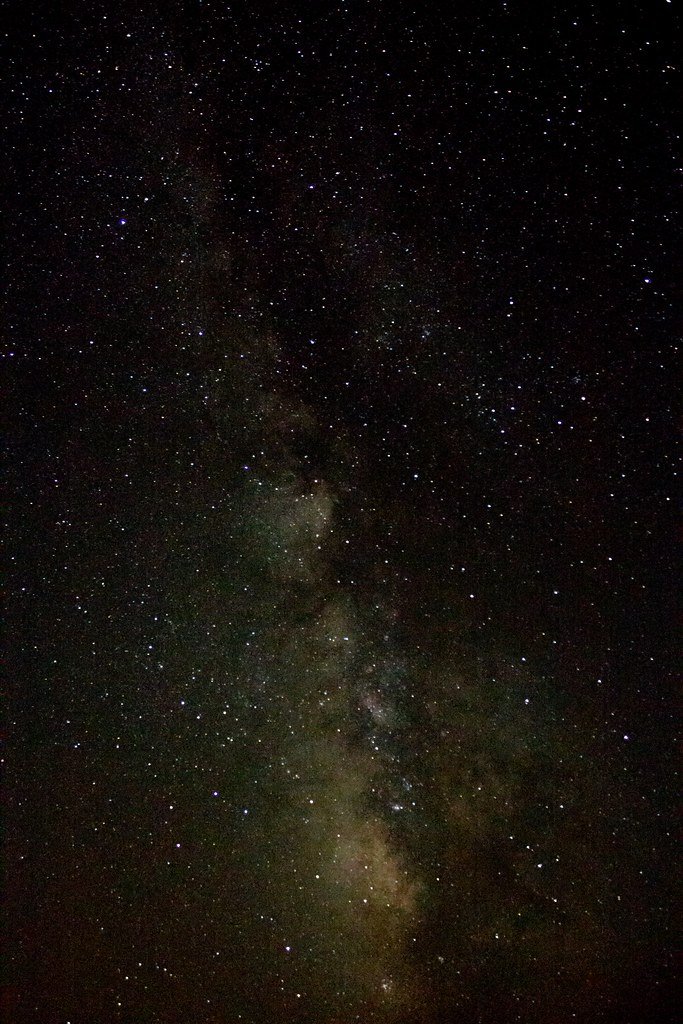
Distance and dust do the rest. Dark lanes such as the Great Rift and the Coalsack block light from stars behind them, so even the brightest part of the galaxy hides much of its own contents from a naked-eye observer.
The two teams that clocked stars around the black hole
Before Sagittarius A* had a portrait, it had a weight estimate. Groups led by Reinhard Genzel and Andrea Ghez measured the orbits of stars very near the galactic center for roughly 30 years, and the paths pointed to a supermassive black hole as the most likely explanation. The two shared the 2020 Nobel Prize in Physics for that work.
Sagittarius A* and its giant cousin M87*
The Milky Way’s black hole is more than a thousand times smaller and less massive than M87*, the first black hole ever imaged, yet the two look strikingly similar near their edges. One difference is time: gas orbits Sagittarius A* in minutes rather than days or weeks, so its appearance kept shifting during observation, and the published picture is an average of many frames.
If you’re into this kind of trivia, you’ll probably also enjoy facts about the universe and facts about the moon. For more on gravity’s extremes, see 5 black hole facts, and for what newer telescopes are finding, try James Webb Telescope discoveries.
Want a piece of the galaxy with your name on it?
Name a Star Gift Box – Personalized Star Kit — a personalized night sky keepsake for a special date.
Disclosure: this is our tracked Amazon affiliate link.
On a dark night the faint band across the sky is the nearest slice of the galaxy, and the black hole at its heart lies about 27,000 light-years beyond it.