
As an Amazon Associate, we earn from qualifying purchases. This post may contain affiliate links.
By Luis Gustavo. See how we research and review our content.
Few machines humanity has ever built have changed our picture of the universe as fast as the James Webb telescope has. Since it began science operations in July 2022, it has forced astronomers to tear up entire chapters of the textbook and rewrite them in real time. In this deep-dive guide, we walk through the James Webb telescope’s biggest discoveries so far — from galaxies that “shouldn’t exist” to a possible, but not confirmed, hint of a biosignature on a distant world — explaining what each finding actually means, without the hype and without the clickbait.
A new kind of eye on the sky: how James Webb actually sees the universe
The James Webb Space Telescope (JWST) is a joint mission from NASA, the European Space Agency (ESA), and the Canadian Space Agency (CSA), built as the successor to the Hubble Space Telescope. But “successor” undersells it — JWST isn’t just a bigger Hubble, it’s a fundamentally different instrument. Where Hubble observes mostly in visible light (the same range our eyes see), the James Webb telescope was designed to observe primarily in infrared light, a wavelength invisible to the human eye but essential for peering through cosmic dust clouds and catching the faint glow of extremely distant, extremely old objects. That single design choice is what lets Webb see farther into space — and therefore farther back in time — than any space telescope before it.
A giant gold-coated mirror: why size matters here
Webb’s primary mirror measures 6.5 meters across, compared to Hubble’s 2.4-meter mirror — a light-collecting area more than six times larger. It’s built from 18 hexagonal segments coated in a thin layer of gold, a material chosen because it reflects infrared light with exceptional efficiency. A bigger mirror gathers more photons, which translates directly into sharper images and the ability to detect objects that are much fainter and farther away. If you’ve seen photos of the telescope before launch, that golden flower of hexagonal panels is exactly this mirror — and that iconic structure has become popular enough that a detailed James Webb Space Telescope model building kit now lets space fans assemble a scale replica of it at home.
The launch and the 344 single points of failure
The James Webb telescope launched on December 25, 2021, aboard an Ariane 5 rocket from French Guiana, and spent roughly a month traveling out to the L2 point. Unlike Hubble, which launched fully assembled inside a space shuttle’s cargo bay, Webb was simply too large to fit ready-made inside any available rocket fairing. Its 6.5-meter mirror and tennis-court-sized sunshield had to be folded up like a piece of extreme engineering origami and then gradually unfolded once in space. That process involved more than 300 deployment mechanisms that all had to work correctly, with no possibility of human repair if anything went wrong — mission engineers referred to this phase as “344 single points of failure.” The complete success of that deployment, finished in January 2022, is remembered today as one of the riskiest and most technically impressive operations ever carried out in space.
The science instruments behind the discoveries
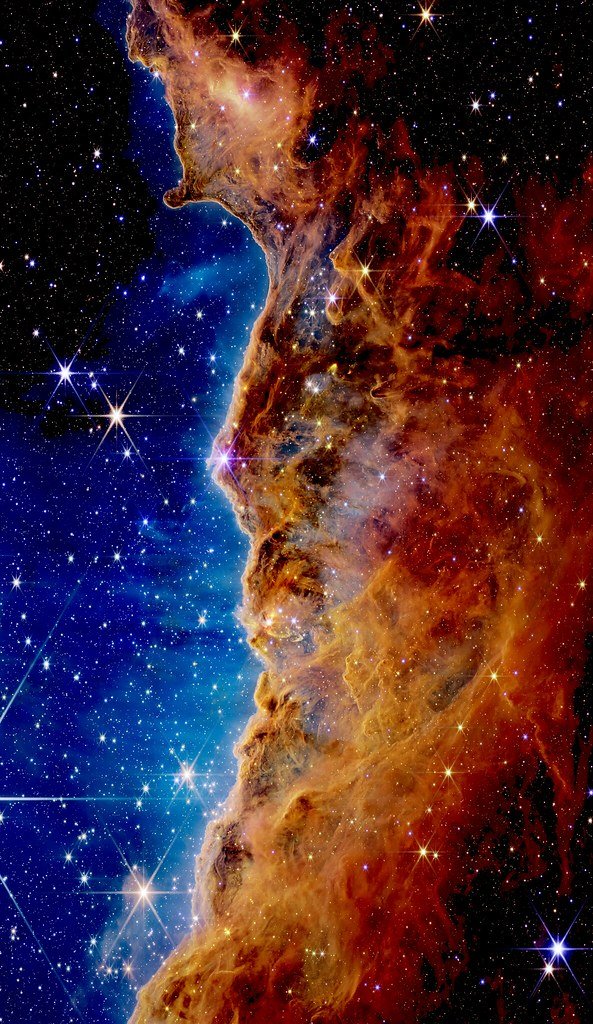
Every James Webb telescope discovery ultimately traces back to four main science instruments, each with a distinct job. NIRCam (Near-Infrared Camera) is the telescope’s primary imaging instrument and is responsible for most of the iconic public images, including the Pillars of Creation. NIRSpec (Near-Infrared Spectrograph) can break the light from hundreds of objects at once into its spectral components, letting scientists identify which chemical elements and molecules — like methane, carbon dioxide, or dimethyl sulfide — are present in a distant atmosphere. MIRI (Mid-Infrared Instrument) observes even longer wavelengths, ideal for studying cold dust, extremely distant galaxies, and the composition of objects like the interstellar comet 3I/ATLAS. Finally, the FGS/NIRISS combines a fine guidance sensor, which keeps the telescope pointed with extreme precision, with an additional spectrograph used mainly for exoplanet studies. It’s the synchronized combination of these four instruments that turns invisible infrared light into the science data rewriting astronomy textbooks.
The “impossible galaxies” that stunned astronomers
One of the most immediate shocks the James Webb telescope delivered came in its very first year of operation: it identified galaxies that had already formed within just 300 to 500 million years after the Big Bang. The problem is that these galaxies were large, massive, and structured — far more so than prevailing cosmological models said should be possible so early in the universe’s history. According to the physics astronomers relied on before Webb, there simply shouldn’t have been enough time for that much matter to clump together into such complex structures that quickly. This finding, informally dubbed the “impossible galaxies” problem, has forced cosmologists to revisit their assumptions about how fast the earliest galaxies can form and grow, including the possibility that star formation in the early universe was far more efficient than anyone expected.
The mysterious “little red dots”
Related to the impossible-galaxies problem but distinct from it is a phenomenon that gained major attention in science coverage throughout 2026: the so-called “little red dots.” These are extremely compact, extraordinarily bright objects blazing with intense star formation in the early universe — far more luminous and more massive than any pre-Webb model predicted could exist so soon after the Big Bang. Astronomers still don’t know exactly what’s powering this brightness: some of these compact, ultra-luminous objects may be hiding entire dense galaxies packed with stars, while others might be actively feeding black holes, generating light as matter falls in at extraordinary rates. It’s one of the most active frontiers in James Webb research right now, and every new observation seems to raise as many questions as it answers.
K2-18b: a possible sign of life that isn’t a confirmation — yet
Perhaps the most talked-about — and most misunderstood — James Webb discovery involves the exoplanet K2-18b, a “sub-Neptune” orbiting its star within the so-called habitable zone. The telescope detected carbon dioxide and methane in this planet’s atmosphere, and in follow-up observations also picked up signs of dimethyl sulfide (DMS), a molecule that, on Earth, is produced only by biological processes such as marine phytoplankton. Precision matters here: this detection came in at roughly 3-sigma statistical confidence, well short of the 5-sigma threshold the scientific community requires to call something a confirmed discovery. In other words, the James Webb telescope did not find life on K2-18b — it found an intriguing but still inconclusive signal that needs more observation time before it can be confirmed or ruled out. Treating this as proof of alien life would be sensationalism; dismissing it entirely would ignore one of the most tantalizing leads in modern astrobiology.
WASP-39b and the first-ever detection of sulfur dioxide on another world
On a separate exoplanet, WASP-39b — a “hot Saturn” with a mass similar to Saturn’s but orbiting extremely close to its star — the James Webb telescope achieved the first confirmed detection of sulfur dioxide in the atmosphere of a world beyond our solar system. This molecule forms through photochemistry: starlight reacts with the gases in the planet’s atmosphere and produces compounds that wouldn’t exist without that constant interaction with the star’s radiation. The discovery matters because it shows that exoplanet atmospheres aren’t static — they’re chemically active, reacting in real time to the light they receive, something scientists could previously only model theoretically and can now measure directly.
The Pillars of Creation like never seen before
One of the most iconic images any telescope has ever captured is the Pillars of Creation, inside the Eagle Nebula — towering columns of gas and dust where new stars are born. Hubble had already photographed this region in visible light back in the 1990s, but in 2022 the James Webb telescope revealed the same landscape in infrared, and the result was stunning: hundreds of young stars, previously completely invisible, hidden inside the dense dust of the pillars, showed up as bright points of light. Because infrared light passes through dust clouds that block visible light, Webb could literally see inside the structures where stars are actively forming. By 2025, extended spectroscopic surveys of this same region let astronomers measure the masses, temperatures, and chemical compositions of these young stellar objects with unprecedented completeness, giving scientists the most detailed portrait ever made of a stellar nursery in progress.
3I/ATLAS: catching a glimpse of a visitor from another star system
In 2025, the James Webb telescope got the chance to observe 3I/ATLAS, only the third interstellar object ever detected passing through our solar system, following the famous ‘Oumuamua in 2017 and comet Borisov in 2019. Using spectroscopy, the telescope analyzed the chemical composition of this visitor from another star system, giving scientists a rare opportunity to study, with extremely precise instruments, physical material that originated outside our own solar system. Every interstellar object that passes close enough to study is a nearly unique chance to compare the chemical “recipe” of other planetary systems with our own, and the James Webb telescope has made that comparison far more detailed than was previously possible.
How the James Webb telescope actually works: extreme cold and the L2 point
To capture infrared light with precision, the James Webb telescope has to stay extremely cold — otherwise, its own heat (plus heat from the Sun, Earth, and Moon) would drown out the faint signals it’s trying to measure, like trying to hear a whisper at a rock concert. That’s why it carries a sunshield the size of a tennis court, built from five ultra-thin layers, which blocks heat and light from the Sun and keeps the science instruments at temperatures just tens of degrees above absolute zero. To make this work, the telescope orbits what’s called the Sun-Earth L2 Lagrange point, roughly 1.5 million kilometers from Earth, on the side facing away from the Sun. At this location, the gravitational pull of the Sun and Earth balances out in a way that lets the telescope follow Earth around the Sun while burning very little fuel, all while keeping its sunshield between the instruments and the heat of three bodies at once — the Sun, Earth, and Moon.
A planetary nebula revealed: NGC 2392
Not every James Webb discovery is about the early universe. In more recent observations, the telescope also produced a striking new image of NGC 2392, nicknamed the “Eskimo” or Lion Nebula, a planetary nebula formed by the outer layers of a dying, Sun-like star. The new infrared view reveals concentric layers of gas shed by the dying star, with a level of detail that shows how this kind of stellar death happens in stages, layer by layer — a preview, in a sense, of what could eventually happen to our own Sun billions of years from now.
How James Webb is reshaping our understanding of planet formation
Beyond studying atmospheres that are already fully formed, the James Webb telescope has also been observing the gas and dust disks around young stars — the nurseries where planets are born. Thanks to its infrared sensitivity, the telescope can detect water ice, complex organic molecules, and even the earliest signs of rocky planet formation inside these disks, in star systems that are still actively taking shape. This kind of observation helps answer a fundamental question: are the chemical ingredients necessary for life, such as simple amino acids and water, already present before a planet even finishes forming? Comparing these protoplanetary disks with what we know about our own solar system’s formation has become one of the fastest-growing research areas since Webb became operational.
What’s next: the open mysteries James Webb is still chasing
The James Webb telescope is nowhere near done making headlines. Among the hottest frontiers in current research: finally figuring out what’s powering the “little red dots”; gathering enough observation time to push the DMS detection on K2-18b (or similar candidate worlds) up to the statistical confirmation threshold; mapping the atmospheric chemistry of rocky exoplanets in more detail, which are much harder to study than gas giants; and continuing to refine models of galaxy formation in light of the “impossibly” ancient galaxies the telescope keeps turning up. The mission carries enough fuel for an estimated 20 years or more of operation, which means the list of James Webb discoveries is likely still just getting started. Every new round of observations has the potential to generate another headline — which is exactly why following James Webb telescope news has become, for a lot of people, almost as habit-forming as following sports scores.
Frequently asked questions about the James Webb telescope
Has the James Webb telescope found life on another planet?
No. What exists is a potential biosignature molecule (dimethyl sulfide) in the atmosphere of the exoplanet K2-18b, detected at a statistical confidence level below the threshold required for scientific confirmation. It’s an intriguing lead, not proof of alien life.
What’s the difference between Hubble and the James Webb telescope?
Hubble observes mainly in visible and ultraviolet light while orbiting a few hundred kilometers above Earth. The James Webb telescope observes primarily in infrared, has a mirror with more than six times the light-collecting area, and operates 1.5 million kilometers from Earth at the L2 Lagrange point — which lets it see objects that are farther away, older, and hidden behind cosmic dust.
Where is the James Webb telescope located?
It orbits the Sun-Earth L2 Lagrange point, a gravitational balance point about 1.5 million kilometers from Earth — nearly four times farther away than the Moon.
Can the James Webb telescope be repaired like Hubble was?
Not in the same way. Hubble sits in low Earth orbit and has received astronaut servicing missions in the past. The James Webb telescope is too far away for that and wasn’t designed for crewed visits, which makes every single component’s flawless performance since launch that much more critical.
What are the most important James Webb telescope discoveries as of 2026?
Among the biggest James Webb discoveries are the unexpectedly massive galaxies formed extremely early in the universe, the mysterious “little red dots,” the possible biosignature on K2-18b, the first-ever detection of sulfur dioxide on an exoplanet (WASP-39b), hundreds of hidden young stars revealed in the Pillars of Creation, and the chemical analysis of the interstellar object 3I/ATLAS.
Will the James Webb telescope completely replace Hubble?
Not exactly — the two operate in different light ranges and complement each other. Hubble continues to make valuable observations in visible and ultraviolet light while both telescopes remain operational.
For anyone who wants to keep following this story
If these James Webb discoveries sparked your curiosity about the universe, take a look at our companion guide on facts about the universe, packed with facts that put the sheer scale of the cosmos into perspective.
And if you’d like a physical piece of the mission that’s rewriting astronomy, this James Webb Space Telescope model building kit is a great way to study the engineering behind that gold-coated mirror and sunshield up close, piecing together the very structure that’s staring into the depths of time.
Disclosure: this is our tracked affiliate link.
Enjoyed this deep dive into the James Webb telescope’s biggest discoveries? Drop a comment with the one that surprised you the most, and share it with anyone else who can’t get enough of space.
If you’re into this kind of trivia, you’ll probably also enjoy solar eclipse.