
As an Amazon Associate, we earn from qualifying purchases. This post may contain affiliate links.
By Luis Gustavo. See how we research and review our content.
In 1996, paleontologists in China described Sinosauropteryx, a small meat-eating dinosaur from Liaoning Province whose fossil still carried a coat of fuzzy filaments. It is generally credited as the first dinosaur outside the bird line found with evidence of feather-like covering, and it quickly made the scaly textbook illustrations look dated.
Paleontology has kept moving since. Dating methods have been refined, new species keep arriving, and the family tree now places living birds inside the dinosaur group. Here are 5 current scientific facts, followed by a closer look at the impact crater that closed the age of the non-bird dinosaurs.
1. Birds are, technically, dinosaurs
According to current scientific consensus, modern birds descend directly from a group of theropod dinosaurs, meaning, technically, dinosaurs were never fully wiped out. The Australian Museum classes birds as specialised coelurosaur theropods, in the same way humans are mammals. Feathers, wishbones and specialised wing joints now belong only to birds, but many of those features first appeared in non-bird dinosaurs, and early birds such as Archaeopteryx, about 150 million years old, still had teeth, long bony tails and clawed hands.
Only a small number of advanced birds got through the end-Cretaceous extinction. The museum notes that they were smaller, grew faster, had higher metabolic rates and more efficient flight systems, traits that may have helped. Today there are over 10,000 bird species. Scientists use “avian dinosaurs” for birds and “non-avian dinosaurs” for the rest, an idea first floated in the 1860s, abandoned for a while and revived by new fossils.
2. Many dinosaurs had feathers, not scales
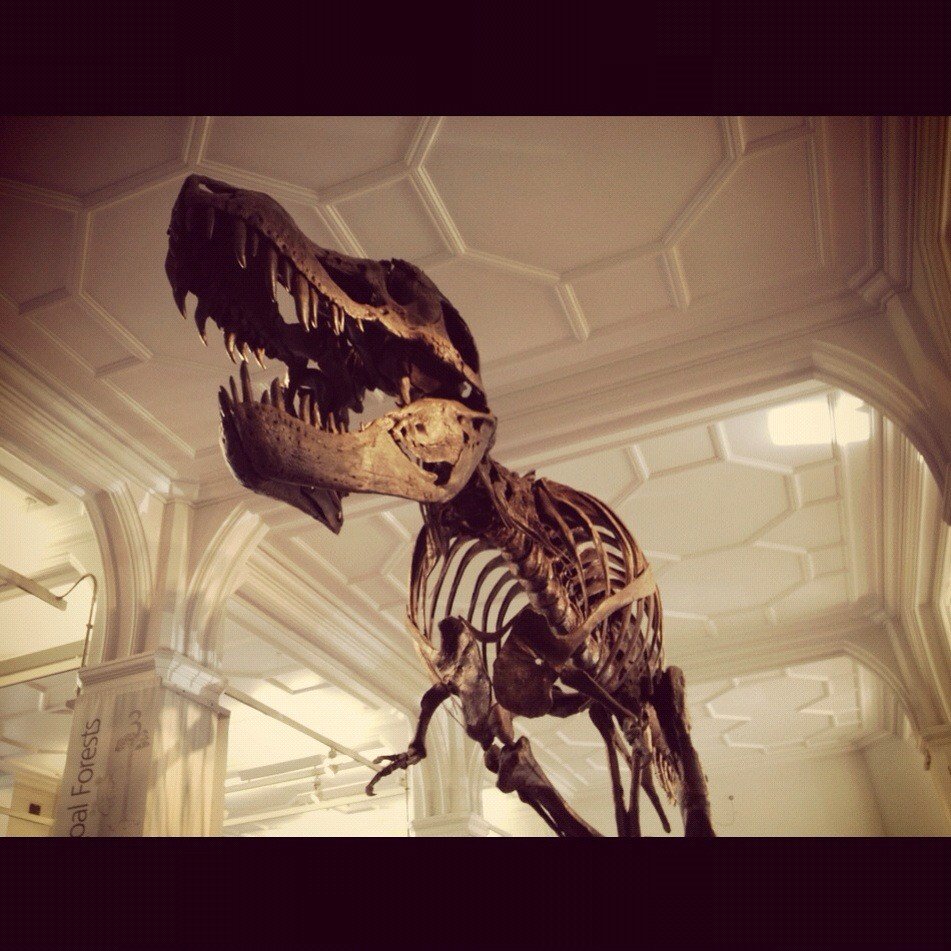
Fossil discoveries in recent decades have shown that several dinosaur species, including close relatives of T-Rex, had feathers, a very different picture from what classic movies portrayed. Sinosauropteryx wore simple, hair-like filaments rather than the branched feathers of a flying bird, probably for insulation. Whether T-Rex itself was feathered is still debated.
The largest known case is Yutyrannus huali, described in the journal Nature in 2012 from fossils in the Yixian Formation of Liaoning. It was about 9 metres long and roughly 1,400 kilograms, in a layer about 125 million years old. Its filaments reached up to 20 centimetres and resembled the fuzz of a chick; they may have helped regulate body temperature, or served as display.
3. T-Rex lived closer in time to us than to Stegosaurus
Stegosaurus lived about 150 million years ago, while T-Rex lived about 66-68 million years ago, meaning more time separates those two species than separates T-Rex from humans. Estimates put Stegosaurus at roughly 155 to 145 million years ago in the Late Jurassic, so the gap to T-Rex is on the order of 80 million years.
Modern humans appeared roughly 300,000 years ago, and T-Rex disappeared about 66 million years ago, so the distance from T-Rex to us is well over ten million years shorter than the one back to Stegosaurus. The Natural History Museum in London gives the overall span of dinosaur rocks as around 240 to 66 million years ago, spread across the Triassic, Jurassic and Cretaceous, which is why “the dinosaurs” is really dozens of eras of animals.
4. Not every “sea” or “flying” dinosaur was actually a dinosaur
Reptiles like pterosaurs (flying) and plesiosaurs (marine) lived during the same era as dinosaurs, but belong to different evolutionary groups, and technically, they aren’t classified as dinosaurs. The Natural History Museum describes plesiosaurs as marine reptiles that are only distantly related to dinosaurs. The earliest known one, Rhaeticosaurus, dates to about 204 million years ago, and the group lasted more than 140 million years.
Sizes varied widely: Plesiosaurus was about 3.5 metres long, Liopleurodon up to roughly 10 metres, and Elasmosaurus had a neck over seven metres long with 72 neck vertebrae. Pterosaurs are a separate branch of reptiles; they share the wider archosaur group with dinosaurs and crocodilians, but they are usually placed in their own lineage, Pterosauria.
5. New dinosaur fossils are still being discovered regularly
New dinosaur species continue to be identified every year around the world, including recent discoveries in South America, including Brazil. Michael Benton’s 2008 review found that naming rose from three or four species a year in the 1950s to around 30 a year since 1990, with 1,401 named through 2004. The Natural History Museum puts the current average at around 50 a year; the gap comes down to what is counted and when.
One Brazilian example is Ypupiara lopai, announced in August 2021, an unenlagiine dromaeosaurid from the Maastrichtian, the final stage of the Cretaceous. Not every new name survives: some species named in the past have since been merged with others or set aside, which is why researchers talk about “valid” species.
The Yucatan crater that closed the age of non-bird dinosaurs
NASA’s Jet Propulsion Laboratory describes Chicxulub, on Mexico’s Yucatan Peninsula, as one of the largest impact craters on Earth: about 180 kilometres wide and 900 metres deep, buried under roughly a kilometre of younger rock. Most scientists treat it as the “smoking gun” for an impact at the end of the Cretaceous, linked to the loss of more than 70 percent of living species, including the non-bird dinosaurs.
The impactor was roughly 10 kilometres across, and whether it was an asteroid or a comet is still unresolved, a question that connects to our guide on comets. That single event helps explain fact one: the small survivors that came through were the ancestors of today’s birds.
Since you made it this far, you’ll probably also like learning more about facts about the oceans and about facts about birds.
Want to be a paleontologist for a day?
Discovery Dinosaur Fossil Dig Kit – T-Rex & Velociraptor — a hands-on way to experience what an excavation feels like.
Disclosure: this is our tracked Amazon affiliate link.
The next time a pigeon struts across a sidewalk, remember that its lineage walked alongside fuzzy giants like Yutyrannus, and came through the aftermath of the Chicxulub impact.