
As an Amazon Associate, we earn from qualifying purchases. This post may contain affiliate links.
By Luis Gustavo. See how we research and review our content.
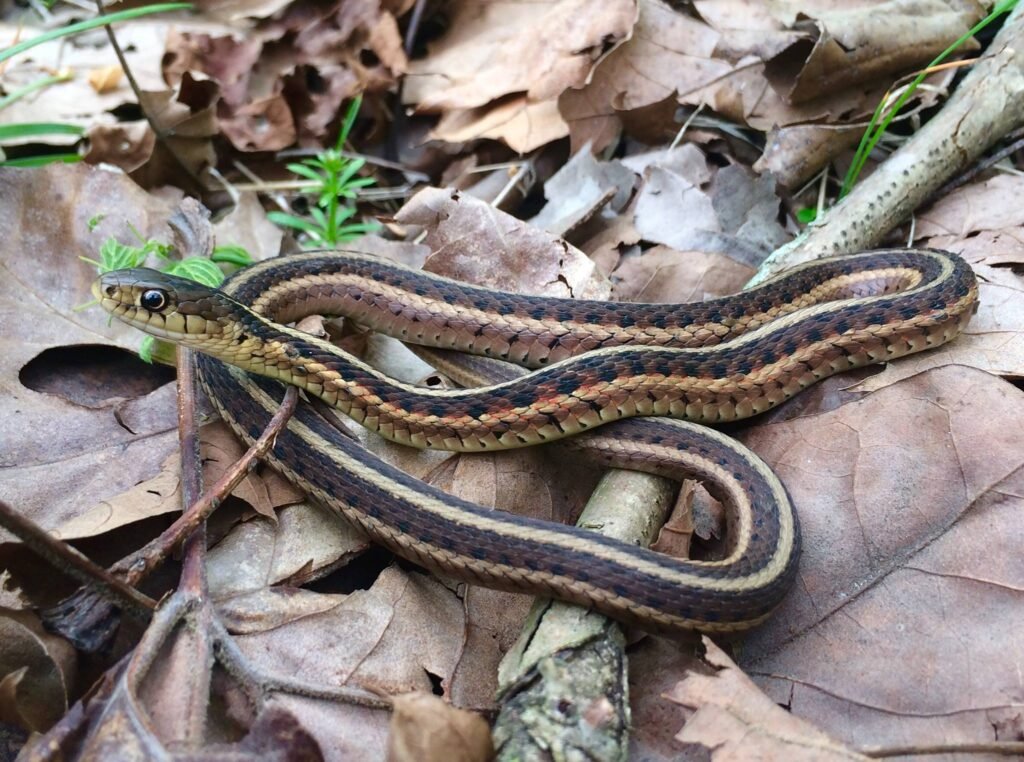
Few animals carry as much cultural weight as snakes: they’re the stuff of myth, instinctive fear, and at the same time one of the most successful reptile groups on the planet, found on every continent except Antarctica. Behind the reputation of a dangerous creature is a surprisingly sophisticated biology — senses humans don’t come close to matching, locomotion styles that change with the terrain, and a much smaller share of dangerous species than most people assume. These 6 facts about snakes show how this animal sees, hunts, and moves in ways that are very different from what its reputation suggests.
1. The forked tongue works like a “nose” that tastes the air
When a snake flicks its tongue out and waves the two tips around, it isn’t threatening anyone — it’s collecting airborne and ground-level chemical particles. Each tip of the forked tongue gathers a separate sample and delivers it to the vomeronasal organ, also called Jacobson’s organ, located in the roof of the mouth. That organ interprets the chemical molecules almost like a separate sense of smell, letting the snake build a three-dimensional map of its surroundings, pick up a recent prey trail, and even work out which direction that prey went. Because each tip moves independently, comparing the chemical concentration between the two sides helps the snake figure out where a scent is strongest, similar to how we use two ears to locate the direction a sound is coming from.
2. Pit vipers can “see” the heat coming off a prey animal’s body
Members of the Viperidae family, such as rattlesnakes and Brazil’s jararaca, have a pair of loreal pits between the eye and the nostril — organs sensitive to tiny shifts in infrared heat. Studies of this type of receptor show sensitivity to temperature differences of just a few thousandths of a degree Celsius, enough to detect a rodent’s body heat at a distance, even in total darkness. The snake’s brain combines that thermal information with the image captured by its eyes, producing something close to a two-channel vision system that dramatically improves strike accuracy. That’s part of why pit vipers hunt so effectively at night, when eyesight alone would be far less useful.
3. No eyelids: why snakes never blink
Unlike most reptiles, snakes don’t have movable eyelids — instead, a transparent scale called a brille (or spectacle) permanently covers and protects each eye, acting like a built-in contact lens fused to the skin. That scale gets shed along with the rest of the skin during ecdysis, the shedding process, which is exactly why a snake’s eyes turn cloudy and bluish shortly before a shed — the fluid that builds up between the old and new skin layers also collects beneath the brille. The practical result is that a snake never closes its eyes, not even while resting, which feeds a good chunk of the myth that it can “hypnotize” prey with a fixed stare.
4. The stretchy jaw that fools a lot of people
It’s common to hear that a snake “dislocates its jaw” to swallow prey bigger than its own head, but that’s not quite what happens. The two halves of the lower jaw aren’t fused at the front the way ours are — they’re connected by an elastic ligament that stretches, letting the two sides spread apart from each other. Add to that a bone called the quadrate, which connects the jaw to the skull far more loosely than our own jaw joint, and the result is a mouth able to open much wider than would otherwise seem physically possible, with no dislocation or “breaking” involved at any point. It’s this set of adaptations, not a temporary injury, that lets a boa constrictor swallow prey twice the diameter of its own head.
5. Only a fraction of nearly 4,000 species are dangerous to humans
There are roughly 3,900 recognized snake species worldwide today, and the large majority of them pose no real threat to people — only around 600 species are estimated to produce venom potent enough to cause clinically significant harm to an adult human. Venom, where it exists, evolved mainly as a hunting tool, to immobilize or begin digesting prey before the bite becomes effective for feeding, rather than primarily as a defensive weapon against larger predators. Many constricting species, like boas and pythons, don’t have venom glands at all: they subdue prey purely through the force of constriction, which cuts off blood circulation within minutes. Even so, widespread fear of snakes tends to treat every species as equally dangerous, which rarely reflects the reality of the specific snake encountered.
6. Slithering isn’t one movement — it’s at least four
Contrary to what the word “slither” suggests, snakes rely on at least four distinct locomotion patterns, chosen based on the terrain. Lateral undulation, the familiar S-shaped movement, pushes the body against irregularities in the ground and is the most common style on surfaces with vegetation or rocks. On loose, hot sand, species like the desert-dwelling sidewinder rattlesnake use sidewinding, a diagonal movement in which only two sections of the body touch the ground at any instant, reducing contact with the heated surface. Heavy-bodied snakes, such as pythons and anacondas, rely on rectilinear movement, almost like a caterpillar, pushing the body forward in a straight line using the belly scales as anchor points. And in tight spaces like burrows and crevices, concertina movement lets a snake advance by bunching and extending its body in segments, without needing open space on either side.
Why it’s worth understanding a widely feared animal a little better
Understanding these mechanisms changes how a snake encountered in the backyard or on a trail actually reads: behavior that looks threatening — the flicking tongue, the fixed stare, a coiled posture — is almost always just the animal’s normal sensory and defensive repertoire, not a provocation. Knowing that repertoire also makes it easier to keep a safe distance without disproportionate panic, since most snake encounters end without incident once a person simply backs away and gives the animal room.
Readers who enjoy this kind of content also tend to like our facts about spiders, another animal group wrapped in instinctive fear and exaggerated myths, and our facts about dinosaurs, distant relatives of today’s reptiles that hide plenty of biology very different from what pop culture usually shows.
Recommended products
Realistic Rubber Snake Decoration — a fun (and completely risk-free) way to enjoy the look of a snake without getting near a real one.
Snake Identification Field Guide Book — useful for anyone who wants to recognize local species and tell harmless snakes from dangerous ones at a glance.
Disclosure: this is our tracked affiliate link.
Which of these snake facts surprised you the most? Share this article with anyone else who finds this animal fascinating (even with a healthy dose of caution).