
As an Amazon Associate, we earn from qualifying purchases. This post may contain affiliate links.
By Luis Gustavo. See how we research and review our content.
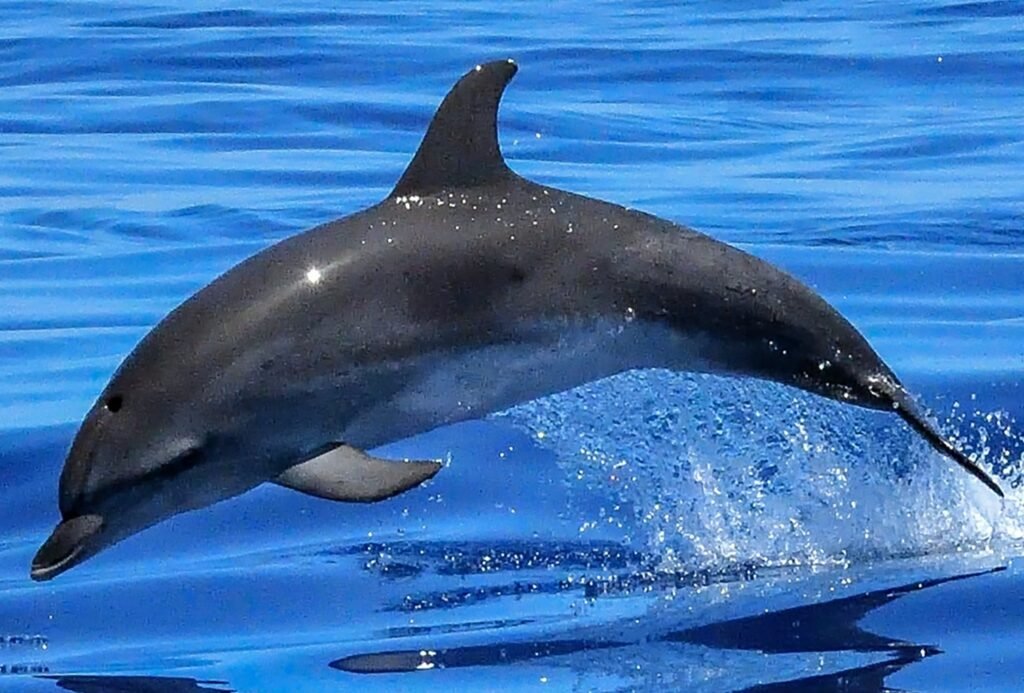
Calling a dolphin “smart” has become such a cliché that most people never learn what it actually means in practice. It’s not just the friendly reputation dolphins get from documentaries and aquariums: decades of field research show they have individual identity, cooperate using strategies that resemble planning, and solve problems in ways that put this marine mammal in a small club of animals — alongside great apes, elephants, and crows — recognized for advanced cognition. These 6 facts walk through concrete field-research examples of what that intelligence actually involves.
1. Every dolphin has a “name” of its own
Bottlenose dolphins develop an individual whistle as calves, known as a signature whistle, that works a lot like a personal name. Researchers at the University of St. Andrews in Scotland documented that other dolphins in the group learn and reproduce that signature to call a specific individual from a distance — something rare in the animal kingdom, where most vocalizations identify a species or an emotional state, not an individual. Mothers in particular repeat their calf’s signature whistle over and over during the first days of its life, a pattern that resembles how human parents repeat a newborn’s name.
2. They sleep with half their brain awake
Dolphins can’t simply “shut off” the way most mammals do, because their breathing is voluntary — every breath requires a conscious decision to surface. To get around this, they evolved unihemispheric sleep: one half of the brain enters deep sleep while the other stays alert enough to control breathing and watch for predators, with the eye opposite the active hemisphere staying open. After a while, the roles switch. It’s essentially the same mechanism, adapted, that migratory birds use to sleep mid-flight.
3. Dolphins genuinely use tools
In Shark Bay, Australia, a group of bottlenose dolphins developed the habit of pulling marine sponges off the seafloor and fitting them over their rostrum before foraging in rough, rocky patches of sandy bottom — the sponge protects their sensitive snout from cuts and stings while they probe the sand for hidden fish. Researchers dubbed the behavior “sponging,” and it passes almost exclusively from mother to daughter across generations, a rare confirmed case of learned cultural tradition, not instinct, backed up by genetic analysis of the group.
4. They recognize themselves in a mirror
Bottlenose dolphins pass the mark test, the same test used to assess self-awareness in chimpanzees and elephants: researchers mark part of the animal’s body with harmless dye in a spot only visible with a mirror’s help, and the dolphin turns repeatedly to inspect the mark — behavior that indicates it understands it’s looking at its own reflection, not another animal. Studies published as early as the 2000s placed dolphins among the first non-primate animals to demonstrate this ability consistently.
5. They hunt in teams using coordinated strategy
Off the coast of Florida, bottlenose dolphins practice a technique called mud ring feeding: one dolphin swims in a tight circle along the shallow seafloor, beating its tail to kick up a wall of mud that forms a ring around a school of fish. Startled and surrounded, the fish leap out of the water right at the inside edge of the ring — where other dolphins in the group are already positioned with their mouths open, waiting for the meal to land inside. The technique requires coordinated positioning among several individuals and is learned through observation, not something a dolphin is simply born knowing how to do.
6. They live in one of the most complex social structures outside primates
Bottlenose dolphin populations studied in Shark Bay form what biologists call a fission-fusion society: groups constantly split apart and recombine throughout the day, but males form stable two- and three-level alliances — small groups of two to three males that cooperate to guard females, which in turn team up with other small groups to form “super-alliances” of up to a dozen males. This layered social architecture, first described in detail in research published in the 2010s, is considered the most complex non-human social structure ever documented, rivaling the sophistication of political alliances observed in chimpanzees.
Intelligence researchers are still mapping
Put these six traits together — individual identity, sleep adapted to voluntary breathing, tool use, self-awareness, strategic cooperation, and layered social politics — and it’s easier to see why dolphins show up so often in animal cognition research. Each of these discoveries took years of field observation to confirm, and researchers keep monitoring the same Shark Bay and Florida populations decade after decade precisely because this kind of complex social behavior only shows up through long-term observation, not quick lab experiments. Newer generations of the same dolphins are still being tracked by name today, which is part of why signature whistles turned out to matter so much in the first place: without a reliable way to tell individuals apart across years, none of the tool-use, alliance, or hunting-strategy findings above could have been confirmed with any confidence.
Anyone into marine wildlife will also enjoy our facts about the oceans, which looks at other species built for life underwater.
Recommended Products
Realistic Dolphin Plush Toy — a fun gift idea for anyone who fell for these animals’ intelligence.
Dolphin and Marine Life Photography Book — a closer look at dolphins and other ocean species in their natural habitat.
Disclosure: this is our tracked affiliate link.
Which of these dolphin facts surprised you the most? Share it with someone else who loves these animals.