
As an Amazon Associate, we earn from qualifying purchases. This post may contain affiliate links.
By Luis Gustavo. See how we research and review our content.
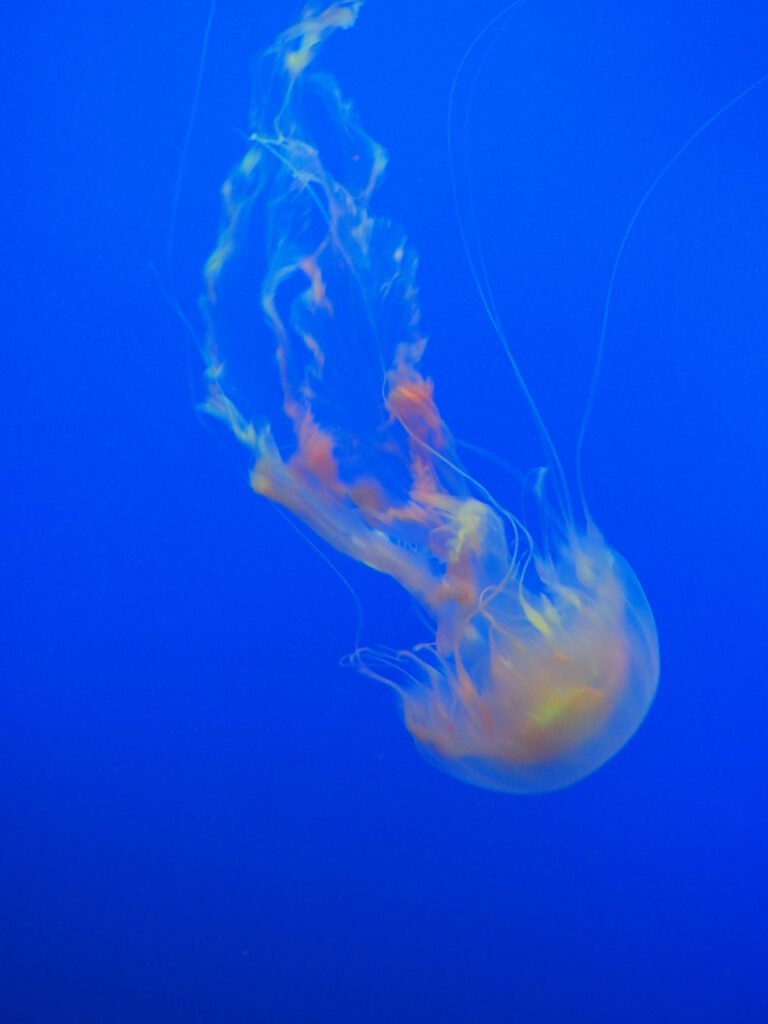
Jellyfish were pulsing through Earth’s oceans long before the first dinosaur ever walked the planet, and their basic body plan has barely changed since. With no brain, no heart, and no bones, these animals have outlasted five mass extinctions while far more complex species vanished around them. These facts about jellyfish show how such a simple body can be, at the same time, one of the ocean’s most efficient predators and one of the most resilient life forms in Earth’s history.
1. Jellyfish have existed for more than 500 million years
Jellyfish fossils found in shale deposits in Utah and Australia date back roughly 500 to 560 million years, to the Ediacaran period — long before the first dinosaurs appeared, about 240 million years ago. Because a jellyfish’s body is almost entirely soft tissue, with no skeleton or shell, finding these fossils is rare: they only form under very specific conditions, when the animal is buried quickly by fine sediment before it decomposes. That makes jellyfish one of the oldest multicellular animal groups still alive today, with a body plan that has stayed largely unchanged for roughly half a billion years.
2. They have no brain, no heart, and no blood
Instead of a centralized nervous system, a jellyfish runs on a diffuse nerve net — a web of neurons spread across the body in a ring around the mouth and bell, with no central organ coordinating decisions. That net is enough to detect light, water chemistry, and touch, and to coordinate the rhythmic pulsing of the bell that propels the animal forward. Without a heart, oxygen reaches the cells through simple diffusion across the extremely thin skin, since a jellyfish’s body is really just a thin layer of tissue sandwiched between two surfaces exposed to water.
3. One species is biologically almost immortal
*Turritopsis dohrnii*, a jellyfish just a few millimeters wide first documented in the Mediterranean Sea, has an ability unique among animals: when injured, stressed, or nearing death from age, it can revert its adult cells back into the polyp stage — the young, fixed phase of the species’ life cycle — and start developing all over again. This process, called cellular transdifferentiation, was first documented in a lab in the 1990s by Italian and Japanese researchers, earning the species its popular nickname, the “immortal jellyfish.” That doesn’t make it indestructible — it can still be eaten by a predator — but in theory, it can repeat this cycle indefinitely.
4. One species’ venom can kill within minutes
The box jellyfish (*Chironex fleckeri*), found in coastal waters of northern Australia and Southeast Asia, is considered by toxicologists to be the most venomous marine animal known. Its tentacles, which can stretch beyond 2 meters (about 6.5 feet), carry millions of stinging cells called nematocysts capable of injecting a toxin that attacks the heart, nervous system, and skin cells all at once. In severe cases, a person can go into cardiac arrest within minutes of contact, which is why this species has been linked to more recorded deaths in Australia over some decades than sharks, crocodiles, and snakes combined.
5. Its body is up to 95% water
The pulsing, floating part of a jellyfish — called the bell — is made almost entirely of a gelatinous substance called mesoglea, sandwiched between two thin layers of cells. That extreme water content is why a jellyfish stranded on a beach practically disappears within a few hours under the sun, leaving behind only a thin, translucent residue. It’s also why a jellyfish’s weight in water is deceiving: a specimen that looks large and heavy usually weighs far less than an animal of equivalent size with a skeleton or shell.
6. Some species glow in the dark — and reshaped modern science
The jellyfish *Aequorea victoria*, found in the North Pacific, naturally produces a bioluminescent protein known as GFP (green fluorescent protein). Isolated and described in the 1960s and 1970s, this protein became one of the most widely used tools in modern molecular biology: scientists use it as a fluorescent “tag” to see in real time where specific genes are active inside living cells, from neurons to cancer cells. The discovery and development of GFP as a research tool earned three scientists the 2008 Nobel Prize in Chemistry — a rare case of a major scientific breakthrough starting with simple curiosity about why a jellyfish glowed in the dark.
Where the name “jellyfish” actually comes from
The English name is a straightforward description of texture — a “fish” made of jelly — even though jellyfish aren’t fish at all; they belong to a separate group called cnidarians, related to corals and sea anemones. In several other languages, the animal is instead named after the Gorgon Medusa from Greek mythology, whose head of living snakes turned onlookers to stone: the resemblance between a jellyfish’s trailing tentacles and that mythical head of serpents inspired the name “medusa,” used in Portuguese, Spanish, French, and Italian. Two very different naming logics, one for texture and one for myth, ended up describing exactly the same animal.
If you enjoy facts about life in the ocean, you’ll also like our article on facts about the oceans, which covers other deep-sea records and mysteries.
If you’re into this kind of trivia, you’ll probably also enjoy facts about owls.
Bring a bit of the ocean into your home
LED Jellyfish Lamp — projects a mesmerizing jellyfish-drifting effect, a relaxing decor pick for a bedroom or reading nook.
Jellyfish Aquarium Tank Kit — for anyone who wants to keep real moon jellies as a low-maintenance desk aquarium.
Disclosure: this is our tracked affiliate link.
Which of these jellyfish facts surprised you the most? Share this with someone else who finds the ocean fascinating.