
As an Amazon Associate, we earn from qualifying purchases. This post may contain affiliate links.
By Luis Gustavo. See how we research and review our content.
The seventh planet from the Sun, Uranus usually gets filed away as “that cold, distant planet” — but few people know it spins in a way no other planet in the solar system does, with its axis nearly lying flat instead of standing upright. An ice giant with a soft blue-green atmosphere, Uranus has been visited by a single spacecraft in all of history and still holds records that puzzle astronomers today. These 6 facts about Uranus cover what’s actually known about this rarely explored planet.
1. Uranus was the first planet discovered with a telescope
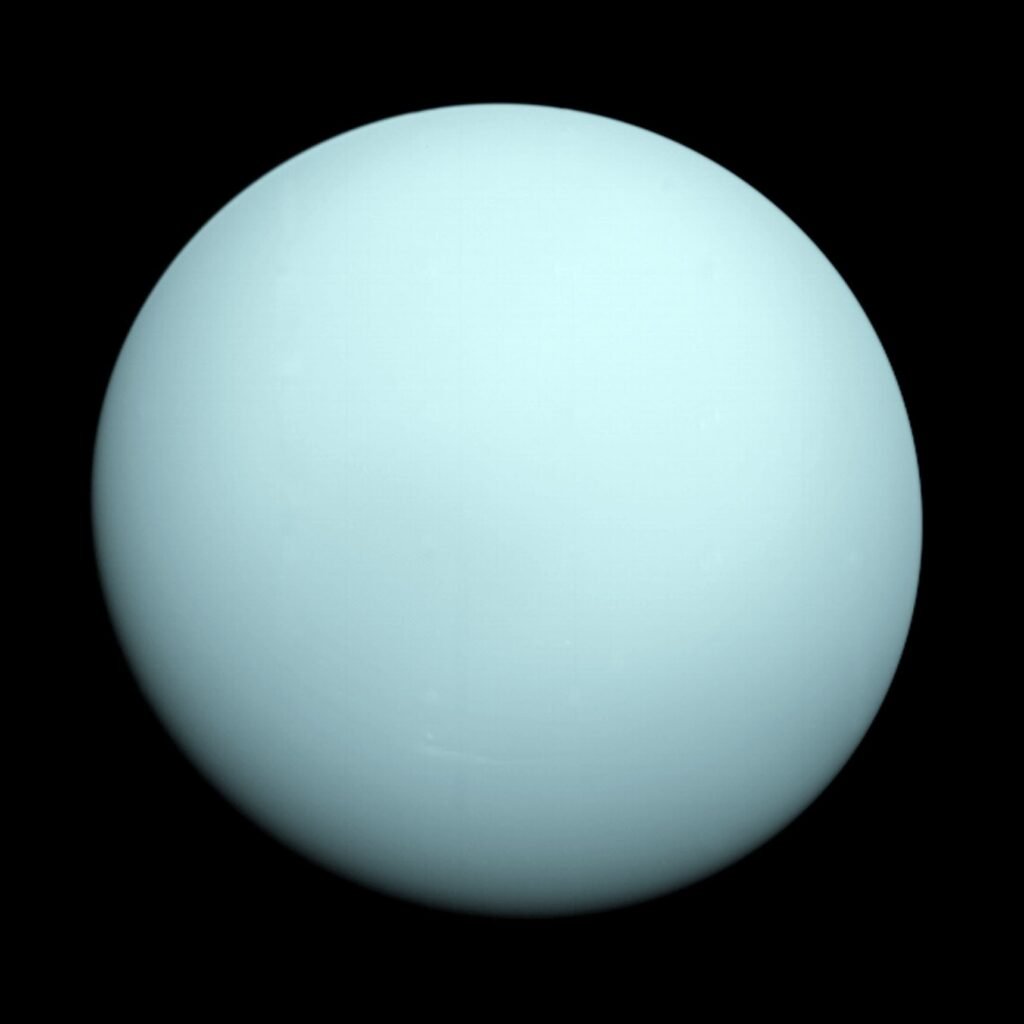
Unlike Mercury, Venus, Mars, Jupiter, and Saturn — all visible to the naked eye and known since ancient times — Uranus wasn’t identified as a planet until 1781, by astronomer William Herschel, who spotted it using a homemade telescope he built himself. Herschel initially thought he’d found a comet, but later orbital calculations confirmed it was a new planet, the first discovered in the modern history of astronomy. Uranus also gets its pale blue-green color from methane gas in its upper atmosphere, which absorbs red light from the Sun and reflects blue and green wavelengths back into space, giving the planet its distinctive, calm-looking hue in photos. The name “Uranus,” after the Greek god of the sky, was only adopted decades later — before that, the planet was briefly called “Georgium Sidus” (George’s Star), in honor of England’s King George III, Herschel’s patron.
2. Uranus spins almost completely on its side
Uranus’s axis of rotation is tilted about 98 degrees relative to its orbital plane — meaning the planet doesn’t spin upright like Earth, but nearly on its side, like a ball rolling flat. That extreme tilt means that, during parts of its 84-Earth-year orbit around the Sun, each pole of Uranus goes through stretches of more than two decades of continuous sunlight, followed by decades of total darkness. The leading theory among astronomers is that a massive impact, likely from a body roughly the size of Earth, struck Uranus during the solar system’s first few million years and knocked the planet nearly onto its side.
3. Uranus has a little-known ring system
Like Saturn, Uranus has rings — but they weren’t discovered until 1977, through a technique called stellar occultation, when astronomers noticed a distant star’s light “blinking” strangely before and after the planet passed in front of it. Today, 13 rings are known around Uranus, much thinner, darker, and harder to spot than Saturn’s bright, icy rings, made mostly of dark dust particles and fragments of rock and ice. That dark coloring is one of the main reasons the rings went unnoticed for so long, even though Uranus itself had already been known for nearly 200 years.
4. Uranus has the coldest atmosphere in the solar system
Despite not being the farthest planet from the Sun — that title belongs to Neptune — Uranus holds the record for the lowest atmospheric temperature ever measured on any planet in the solar system, dropping to around -224°C in its upper layers. Scientists attribute this record to how much internal heat each planet still retains from its formation: Neptune releases a meaningful amount of its own internal heat, but Uranus, for reasons not yet fully understood, appears to have lost or never built up that extra internal heat, leaving it with an atmosphere even colder than its more distant neighbor’s.
5. Uranus’s moons are named after Shakespeare characters
Uranus has 27 confirmed moons, and nearly all of them are named after characters from William Shakespeare’s plays and Alexander Pope’s poems, rather than the Greco-Roman mythology used to name most other planets’ moons. The five largest — Titania, Oberon, Umbriel, Ariel, and Miranda — have icy surfaces covered in craters, fault lines, and deep canyons, with Miranda in particular showing one of the strangest terrains ever photographed in the solar system, including cliffs that may be several kilometers tall. Titania and Oberon, the two biggest, are each roughly half the diameter of Earth’s Moon, and scientists suspect some of these moons may hide a layer of liquid water beneath their icy crusts, similar to what has been found on some moons of Jupiter and Saturn.
6. Uranus has only ever been visited up close once
In the entire history of space exploration, only one spacecraft has ever flown past Uranus: NASA’s Voyager 2, during a single flyby in January 1986, on its way to its next encounter with Neptune. That brief flyby produced the most detailed data ever gathered about the planet, its rings, and its moons, but it also made clear how much is still unknown — no dedicated mission to orbit Uranus has launched since, even though the United States’ planetary science review committee has recently recommended that a Uranus orbiter mission become a priority for the coming decades. Anyone who enjoys this kind of fact might also like our piece on facts about Mars and facts about the Moon, two other solar system bodies already visited up close by spacecraft and astronauts.
Recommended products
3D Planet Night Light (Solar System Decor) — a decorative way to keep this kind of space curiosity close by at home, in a bedroom, or on a study desk.
Beginner Astronomy Binoculars — an easy first step into stargazing for anyone who got curious about the outer planets after reading this.
Disclosure: this is our tracked affiliate link.
Which of these Uranus facts surprised you the most? Share this article with anyone else who loves astronomy.