
As an Amazon Associate, we earn from qualifying purchases. This post may contain affiliate links.
By Luis Gustavo. See how we research and review our content.
Democracy, theater, the Olympics, geometry: much of the vocabulary we still use today to organize society, entertainment, and science traces directly back to Ancient Greece, a civilization organized not as a single empire but as a network of independent city-states, each with its own laws, armies, and rivalries. Athens, Sparta, Corinth, and Thebes competed with each other as much as they cooperated against outside threats, and it was in that environment of constant rivalry that ideas emerged which have carried, largely intact, across more than two thousand years into the world we live in today. These 6 facts about Ancient Greece show how this civilization came up with surprisingly sophisticated answers to problems we still argue about today.
1. Athenian democracy was direct — and far more limited than it sounds
In Athens, democracy didn’t work through elected representatives the way most countries run today: citizens themselves gathered periodically in the Ecclesia, the popular assembly, to vote directly on laws, war, and public spending. The detail that tends to surprise people is who actually got to take part: only free men born to Athenian parents counted as citizens, which excluded women, resident foreigners, and the large enslaved population — in practice, a relatively small share of the city’s total inhabitants decided for everyone else. Athenians also used a curious mechanism called ostracism: once a year, the assembly could vote, with a citizen’s name scratched onto a piece of broken pottery called an ostrakon, to banish someone from the city for ten years if enough people saw them as a threat to political stability, even without any proven crime.
2. At the original Olympics, wars paused and athletes competed naked
The ancient Olympic Games were held every four years at Olympia in honor of Zeus, with records traditionally dating the first games to 776 BCE, and they mattered so much to Greek identity that a sacred truce, the ekecheiria, temporarily suspended armed conflicts between city-states so athletes and spectators could travel there safely. Only free Greek-speaking men could compete, and they did so completely naked — the word “gymnastics” itself comes from gymnos, Greek for “naked” — while married women were banned from even watching the events, on pain of death according to some ancient accounts. Unlike the modern games, there were no gold, silver, or bronze medals: the only official prize was a wreath woven from wild olive branches cut from a sacred tree near the temple of Zeus, though winners typically returned home to generous rewards and lasting prestige.
3. Socrates never wrote a single line — and still shaped all of Western philosophy
Everything we know about Socrates’s thinking comes from other people’s accounts, mainly his student Plato and the historian Xenophon, since the philosopher himself never left behind any written text, preferring spoken debate in the public squares of Athens. His method, now known as the Socratic method, consisted of asking a series of questions to expose contradictions in someone’s reasoning, a technique still used in classrooms, courtrooms, and even therapy today. That same habit of publicly questioning established beliefs ended up costing Socrates his life: in 399 BCE, he was tried and convicted for “corrupting the youth” and for not recognizing the city’s gods, and the sentence was carried out by drinking hemlock, a plant-based poison, an episode described in detail by Plato in the dialogue known as “Phaedo.”
4. The Parthenon’s columns curve on purpose, to trick the eye
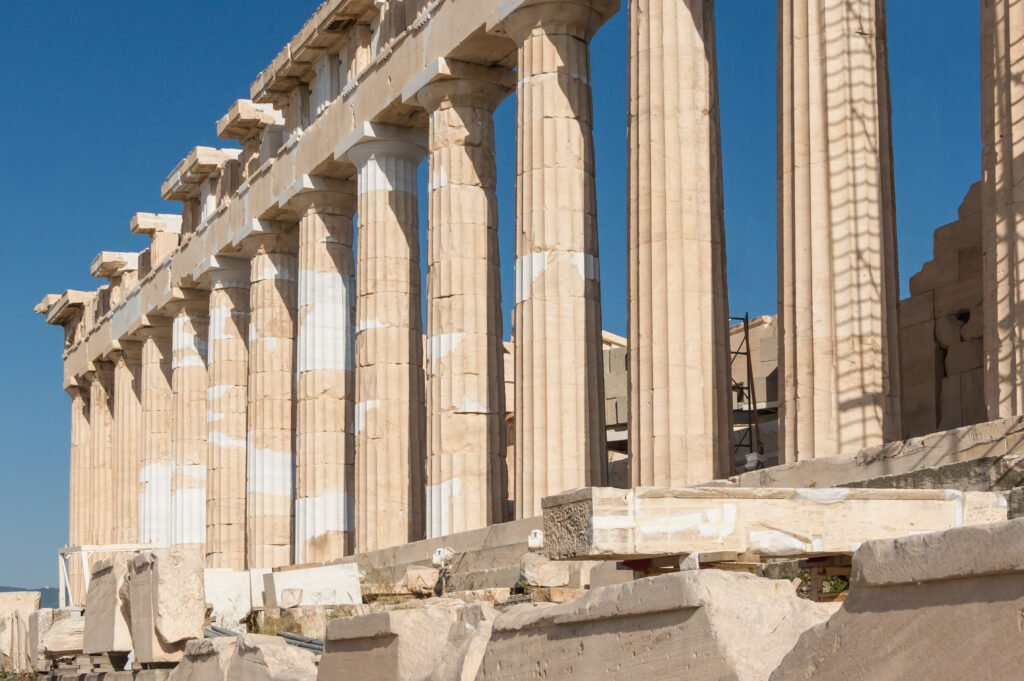
The Parthenon, built in Athens between 447 and 438 BCE under the political leadership of Pericles and designed by architects Iktinos and Kallikrates, hides a series of optical adjustments so subtle they go unnoticed to the naked eye: the columns aren’t perfectly straight but slightly bulge in the middle (an effect called entasis), and the temple’s floor curves discreetly upward toward the center instead of lying completely flat. These adjustments correct optical illusions that would make truly straight columns look too thin in the middle, or a truly flat floor look like it sags when viewed from a distance — in practice, the Greeks deliberately “distorted” the building so it would look geometrically perfect from afar. The temple’s decorative sculpture, including the frieze and pediments, was overseen by the sculptor Phidias, also responsible for the colossal statue of Athena that originally stood inside the temple.
5. Greek theater grew out of a religious festival — and still shapes drama today
Western theater as we know it traces back to the Dionysia, religious festivals held in Athens in honor of the god Dionysus, where competitions between plays were a central part of the celebration, not entertainment set apart from religion. It was in that context that the great names of Greek tragedy emerged — Aeschylus, Sophocles, and Euripides — alongside Aristophanes, the master of comedy, playwrights whose works introduced dramatic structures (like a protagonist’s central conflict and the role of the chorus) still present in today’s film and TV. Greek theaters were also feats of acoustic engineering: the theater of Epidaurus, built in the 4th century BCE with room for thousands of spectators, has geometry so precise that, according to architectural acoustics studies, a whisper from center stage can be heard clearly in the back rows, without any artificial amplification.
6. A Greek scholar measured Earth’s circumference using nothing but shadows, around 240 BCE
Eratosthenes, chief librarian of the Library of Alexandria, calculated Earth’s circumference with striking accuracy for the era using nothing more than the difference in the angle of the sun’s noon shadow between two Egyptian cities, Syene and Alexandria, whose distance apart he knew. His result landed close to the value accepted today, a remarkable feat considering he had no instrument beyond sticks, shadows, and basic geometry. That same empirical mindset shows up elsewhere: Hippocrates laid the groundwork for medicine as a discipline based on observation rather than purely supernatural explanation, giving rise to the oath that still carries his name, while Euclid systematized much of plane geometry in a single treatise, “Elements,” used as a standard textbook for more than two thousand years afterward.
Readers who enjoy comparing this civilization with other ancient powers will also like our facts about ancient Egypt, another great Mediterranean civilization from around the same era, and our facts about Roman gladiators, a civilization that borrowed and adapted much of Greek culture centuries later.
Recommended products
Book on Ancient Greek History — for anyone who wants to go deeper into the democracy, philosophy, and city-states this article can only skim.
Decorative Miniature Greek Doric Column Replica — a nod to classical Greek aesthetics for a shelf or desk.
Disclosure: this is our tracked affiliate link.
Which of these Ancient Greece facts surprised you the most? Share this article with anyone else who’s into ancient history.