
As an Amazon Associate, we earn from qualifying purchases. This post may contain affiliate links.
By Luis Gustavo. See how we research and review our content.
While other great ancient civilizations rose and eventually collapsed, ancient China kept a rare kind of cultural and political continuity, with dynasties succeeding one another for more than two thousand years over roughly the same territory and the same foundation of writing. It was there that inventions emerged that reshaped the entire world long before reaching Europe, along with one of the longest engineering projects humans have ever built. These 6 facts about ancient China show why this civilization is still studied as one of history’s most influential.
1. The Great Wall wasn’t built all at once
The Great Wall of China isn’t a single, continuous structure, but rather a network of walls, forts, and barriers built and rebuilt by different dynasties over more than two thousand years, starting with isolated sections in the 7th century BCE and taking a more unified shape under the first emperor in the 3rd century BCE. An official Chinese survey completed in 2012, using modern mapping technology, measured the total length of every section ever built — including branches, parallel walls, and sections already in ruins — at roughly 21,196 kilometers, far longer than the popular estimate of “just” 8,000 kilometers. The wall was built mainly to hold off raids from nomadic peoples to the north, and much of the most-visited stretch today, near Beijing, dates to the Ming dynasty, between the 14th and 17th centuries.
2. An entire army of terracotta guarding a tomb
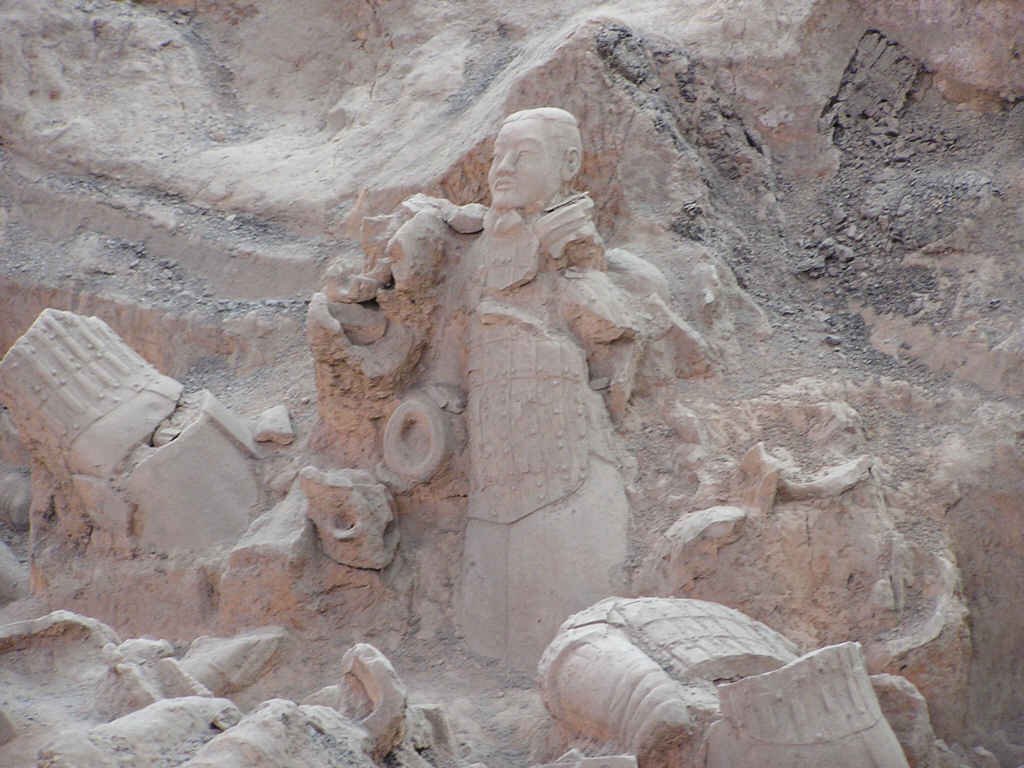
In 1974, a group of farmers digging a well in Shaanxi province accidentally stumbled onto one of the biggest archaeological finds of the 20th century: an army of more than 8,000 life-sized terracotta soldiers, along with horses and chariots, buried over two thousand years earlier to protect the tomb of Emperor Qin Shi Huang, the first to unify China. The most striking detail is that no two figures are identical — faces, hairstyles, armor, and posture all vary from soldier to soldier, suggesting a production process that combined standardized parts with individual finishing touches. Historians estimate the full funerary complex, still only partly excavated out of respect for preservation techniques, spans dozens of square kilometers around the main tomb.
3. Four Chinese inventions that changed the world
Ancient China is credited by historians as the birthplace of the so-called “Four Great Inventions”: paper, traditionally attributed to court official Cai Lun around 105 CE; gunpowder, discovered by accident during alchemical experiments searching for an elixir of immortality around the 9th century; woodblock printing, which let texts and images be reproduced centuries before Gutenberg’s press appeared in Europe; and the magnetic compass, originally used for divination before being adapted for navigation. All four technologies took centuries to reach the West along trade routes, and each one had a direct impact on how wars were fought, books were distributed, and ships crossed oceans once adopted outside China.
4. An emperor who standardized an entire country
Qin Shi Huang became the first emperor of a unified China in 221 BCE, after conquering the last rival kingdoms fighting over the territory, ending a long stretch known as the Warring States period. During his reign, he standardized writing, weights and measures, and even the axle width of carts across the entire territory, measures that made trade and administration much easier in a newly unified, culturally diverse country. He also kicked off the connected construction of the Great Wall and ordered roads and canals built to link regions that had previously been isolated from one another. Despite that lasting legacy, his rule was marked by mass forced labor and rigid laws, and the Qin dynasty he founded lasted only a few years after his death.
5. Confucius shaped how the country was governed for over two thousand years
The philosopher Confucius, who lived between 551 and 479 BCE, developed ideas about ethics, social hierarchy, and good governance that became the official foundation of Chinese public administration for much of imperial history — later dynasties adopted exams based on Confucian classics to select government officials, a system of literate meritocracy that predates anything comparable in Europe by centuries. Alongside it, Taoism, tied to the semi-legendary figure of Laozi, offered a more contemplative path focused on living in harmony with the natural flow of things, and it influenced both philosophy and traditional Chinese medicine. These two schools of thought coexisted, sometimes in tension, shaping Chinese culture in ways still visible today.
6. Silk was once a closely guarded state secret
Silk production from silkworm cocoons was dominated by China for centuries before any other civilization knew how the fabric was actually made, and revealing the secret of sericulture to foreigners was treated as a serious crime, punishable by death during certain periods of Chinese history. It was precisely that luxury fabric, highly prized in the Roman Empire and other distant regions, that gave its name to the network of trade routes linking China to the West — a topic we cover in more depth in our facts about the Silk Road article. According to historical accounts, the secret only reached the West centuries later, through monks said to have smuggled silkworm eggs hidden inside hollow bamboo canes during the Byzantine period.
Anyone who enjoys comparing ancient civilizations can also check out our facts about ancient Greece, another society that left a lasting legacy in philosophy, science, and political organization.
Recommended products
Ancient China History Book — for anyone who wants to dig deeper into the dynasties, inventions, and philosophies that shaped this civilization.
Terracotta Warrior Replica Statue — a decorative replica inspired by the famous Terracotta Army.
Disclosure: this is our tracked affiliate link.
Which of these ancient China facts surprised you the most? Share this article with anyone else who loves ancient history.