
As an Amazon Associate, we earn from qualifying purchases. This post may contain affiliate links.
By Luis Gustavo. See how we research and review our content.
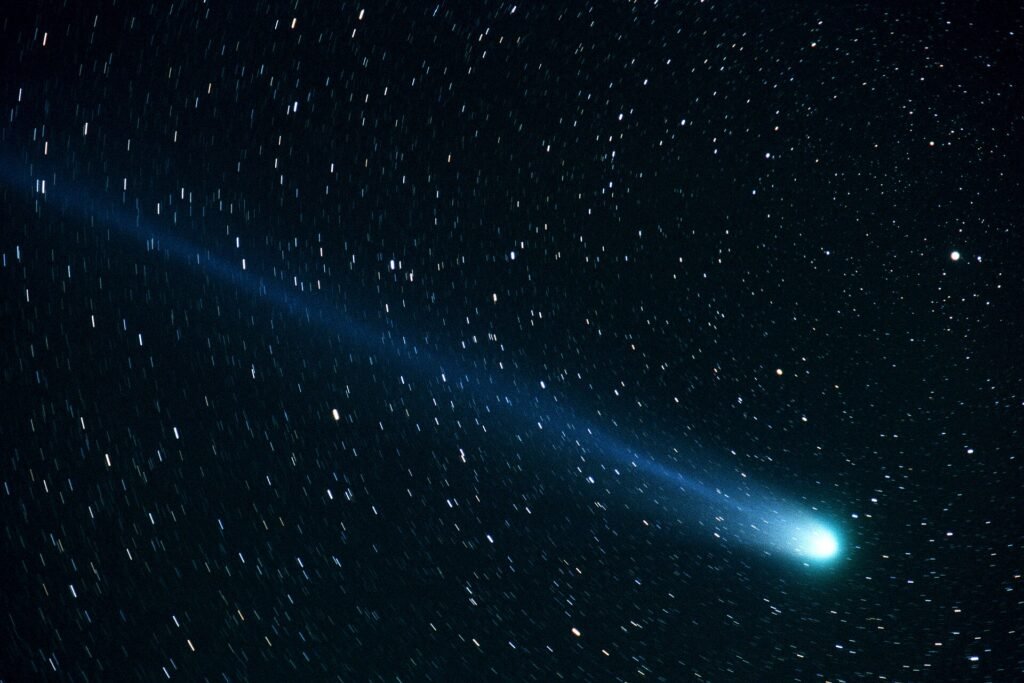
Few sights in the night sky spark as much curiosity as a comet streaking by with a glowing trail behind it. Unlike a planet or a star, a comet is basically a dirty block of ice from the coldest, most distant edges of the Solar System, and it only starts to shine once it gets close enough to the Sun to begin breaking apart. These 6 facts about comets show why these icy wanderers have fascinated astronomers and backyard observers alike for centuries.
1. A comet is literally a “dirty snowball”
A comet’s nucleus is made of water ice, other frozen gases, dust, and rock, all packed into a body usually just a few kilometers across — astronomer Fred Whipple coined the phrase “dirty snowball” in 1950 to describe exactly this makeup, and the idea was confirmed decades later by direct spacecraft observations. While a comet sits far from the Sun, in the frozen outer reaches of the Solar System, it stays essentially frozen and invisible to the naked eye, with nowhere near enough brightness to notice from Earth. It’s only when it swings close to the Sun that heat starts vaporizing the outer layers of ice, releasing gas and dust that form a temporary atmosphere around the nucleus called the coma — often larger in volume than the planet Jupiter, despite the solid nucleus itself being tiny.
2. A comet’s tail never points the way it’s traveling
One of the most common misconceptions is assuming a comet’s tail always trails behind it, like a jet’s contrail — in reality, it always points away from the Sun, pushed by solar wind and the pressure of sunlight, regardless of which direction the comet is actually moving. That means once a comet has passed the Sun and is heading back out, its tail actually leads in front of the comet’s body, not behind it. Comets typically grow two separate, visible tails: a curved, yellowish dust tail made of solid particles pushed by sunlight, and a straight, bluish ion tail made of electrically charged gas reacting to the solar wind. Some historically recorded comet tails have stretched past 100 million kilometers long, longer than the distance between Earth and the Sun.
3. Orbits range from decades to hundreds of thousands of years
Short-period comets, like Halley, complete one trip around the Sun in under 200 years and typically come from a region called the Kuiper Belt, beyond Neptune’s orbit. Long-period comets, on the other hand, originate from a much more distant, largely theoretical region called the Oort Cloud, and can take thousands or even millions of years to complete a single orbit, traveling trillions of kilometers away before circling back. Halley’s Comet, the most famous of all, swings back into view from Earth roughly every 76 years, which means most people only get one realistic chance to see it in their lifetime. Its last visible pass was in 1986, and its next is expected in 2061.
4. Halley’s Comet was recorded by ancient civilizations over 2,000 years ago
Records of Halley’s Comet’s passage appear in Chinese astronomical notes dating back to at least 240 BCE, and the comet is also depicted in the Bayeux Tapestry, an 11th-century embroidery documenting the Norman conquest of England in 1066 — at the time, its appearance was read as an omen tied to the coming battle. Centuries later, in 1705, astronomer Edmond Halley calculated that comets observed in 1531, 1607, and 1682 were actually the same object returning periodically, and correctly predicted its return in 1758, earning the comet its name even after his death. Another comet that made recent history was Hale-Bopp, discovered in 1995 and visible to the naked eye for roughly 18 straight months in 1996 and 1997, one of the longest visibility windows ever recorded for a comet.
5. Comets may have delivered part of Earth’s ocean water
One of the most debated hypotheses among planetary scientists is that comet impacts on the early Earth, billions of years ago, contributed part of the water that now makes up the oceans, along with simple organic molecules that may have helped set the chemical stage for life to emerge. The European Rosetta mission, which landed the Philae probe on comet 67P/Churyumov-Gerasimenko’s nucleus in 2014, found a hydrogen isotope ratio in that comet’s water different from Earth’s own water, suggesting not every comet is an equally good candidate for that origin story — the question is still far from settled. Even so, the discovery of amino acids and other complex organic molecules in comet samples keeps this hypothesis among the most studied explanations for where life’s chemical building blocks on Earth came from.
6. The most famous meteor showers are leftovers from ancient comets
When a comet passes close to the Sun repeatedly over centuries, it leaves behind a trail of dust and small fragments scattered along its orbit. If Earth crosses that trail every year, around the same time, the result is a predictable, recurring meteor shower — the Perseids, one of the most watched showers in the northern hemisphere, are leftovers from comet Swift-Tuttle, while the Leonids come from comet Tempel-Tuttle. These fragments, usually no bigger than a grain of sand, burn up in Earth’s atmosphere at speeds above 200,000 km/h, creating the streaks of light seen in the sky. Anyone curious about this phenomenon can check out our piece on facts about meteor showers, which covers other annual showers and the best way to watch them.
For a bigger-picture look at the scale comets move through, our facts about the universe piece covers even wider distances and timescales.
Recommended products
Beginner Telescope for Stargazing — a solid entry point for watching the night sky from home and trying to spot comets bright enough to see with the naked eye or low magnification.
Solar System Wall Poster — a decorative way to keep this kind of space curiosity close by day to day.
Disclosure: this is our tracked affiliate link.
Which of these comet facts surprised you the most? Share this article with anyone else who loves astronomy.