
As an Amazon Associate, we earn from qualifying purchases. This post may contain affiliate links.
By Luis Gustavo. See how we research and review our content.
No stretch of ocean carries as much weight in popular culture as the Bermuda Triangle, an area of the Atlantic tied to decades of stories about ships and planes that supposedly vanished without a trace. Behind the legend, though, is a curious mix of real natural phenomena, statistical coincidence, and a rumor that took on a life of its own starting in the 1960s. These facts about the Bermuda Triangle separate what’s actually documented from what is, in practice, modern folklore.
1. The area sits between Miami, Bermuda, and Puerto Rico
The Bermuda Triangle is generally defined as the region of the North Atlantic Ocean bounded by three points: Miami, Florida; the islands of Bermuda; and San Juan, Puerto Rico. Depending on who draws the map, the area covers somewhere between 500,000 and 600,000 square miles of ocean — larger than the state of Texas. There is no official or internationally recognized geographic definition for these boundaries: the “triangle’s” own outline shifts from one book or article to the next, which is one of the first hints that this is more of a popular concept than a scientific classification.
2. The most famous case involved five U.S. Navy planes
On December 5, 1945, a group of five TBM Avenger torpedo bombers, known as Flight 19, took off from Florida for a routine training exercise and never returned to base, taking 14 crew members with them. A rescue seaplane sent hours later to search for them also disappeared, with 13 more people on board. Official Navy records, declassified decades later, show the lead pilot radioing that he was disoriented, with his compasses giving conflicting readings, shortly before the planes ran out of fuel — an outcome consistent with a navigation error made worse by bad weather, but one the media of the time turned into the starting point of the modern Triangle legend.
3. Statistically, the region isn’t more dangerous than other busy routes
In 1975, author and librarian Lawrence David Kusche published a detailed investigation into dozens of cases attributed to the Triangle and found that many had been exaggerated, poorly documented, or had actually occurred outside the triangle’s own boundaries. Lloyd’s of London, the British insurer that has calculated maritime risk professionally for decades, has publicly stated it doesn’t charge higher premiums for vessels crossing the region, precisely because its own internal data shows no above-average rate of losses for an ocean area with this much air and sea traffic. The U.S. Coast Guard has reached the same conclusion in its own official reports on the region.
4. Science does point to real natural phenomena in the area
That doesn’t mean the region is free of genuine risk. The Bermuda Triangle sits under the direct influence of the Gulf Stream, one of the strongest and most unpredictable ocean currents on the planet, capable of quickly erasing any surface trace of wreckage. The region also lies in the path of tropical storms and hurricanes that can form with little warning, and the seafloor in parts of the Triangle holds large deposits of methane hydrates — a compound that, if suddenly released as rising bubbles, lowers the density of the surrounding water and could, in theory, affect a small vessel’s buoyancy, though this specific mechanism has never been confirmed as the actual cause of any documented shipwreck.
5. The modern legend was born from a 1964 magazine article
While isolated reports of disappearances in the region had circulated for decades, the term “Bermuda Triangle” was only coined and popularized in February 1964, in an article by writer Vincent Gaddis for the American magazine Argosy. Ten years later, author Charles Berlitz published the book *The Bermuda Triangle* (1974), which sold more than 20 million copies worldwide and cemented the sensationalized version of the story — including theories about Atlantis and supernatural forces that had no basis in the original records of the cases it cited. It was this book, far more than the events themselves, that turned the Triangle into a global pop-culture phenomenon.
6. Compasses really do behave differently there
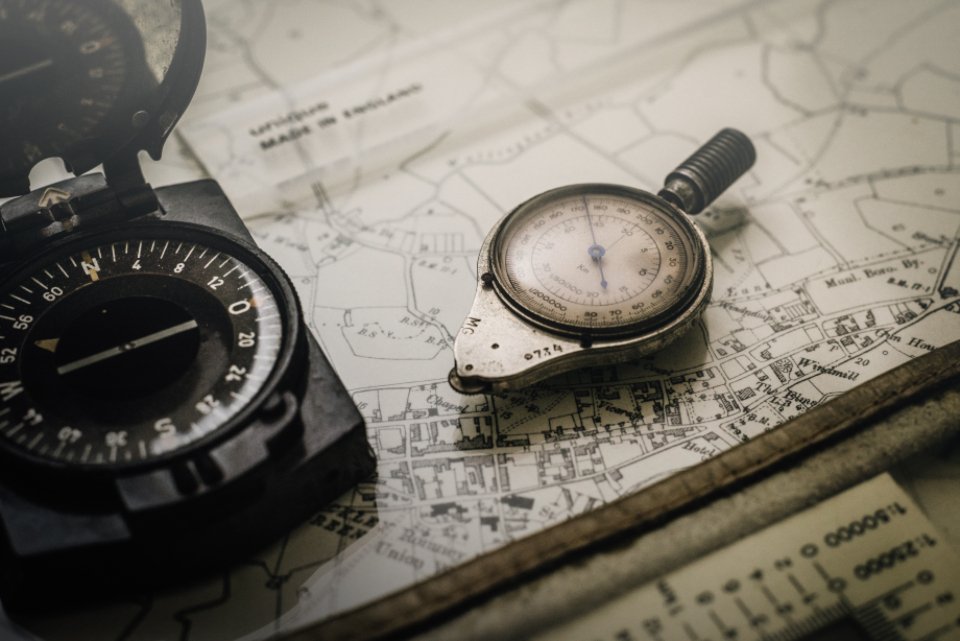
There’s a real, non-mystical explanation behind old reports of “crazy compasses” in the region: the Bermuda Triangle is one of the few places on Earth where magnetic north (where a compass needle points) and true geographic north are almost perfectly aligned — a condition called an agonic line. Across most of the world, navigators have to manually calculate the difference between the two norths to stay on course; in the Triangle, that difference is close to zero, which can confuse anyone used to making that adjustment automatically, leading them to navigate imprecisely by compensating for a gap that, in this particular spot, doesn’t actually exist.
What the official reports actually say
Both the U.S. Navy and the Coast Guard maintain the public position that the Bermuda Triangle is not an officially recognized geographic area, nor is it statistically more dangerous than any other stretch of ocean with heavy traffic and exposure to tropical storms. Most of the cases cited as “unexplained” over the years were later tied to identifiable causes once investigated in depth: navigation error, mechanical failure, severe weather documented at the time, or simply accounts distorted by decades of repetition in sensationalized books and documentaries.
If you enjoy this kind of mystery, you’ll also like our article on facts about shipwrecks, which covers other real cases of vessels lost at sea.
If this topic interests you, it’s worth checking out our piece on historical mysteries science still hasn’t fully solved.
Want to dig deeper into the ocean’s mysteries?
Unsolved Ocean Mysteries Book — a collection of documented cases and the theories behind the sea’s most famous episodes.
Vintage Nautical Compass — a classic-style navigation compass replica, a decor piece for anyone drawn to stories of the sea.
Disclosure: this is our tracked affiliate link.
Do you think there’s something genuinely unusual about the Bermuda Triangle, or is it just a legend well told? Share this with someone else who’s into this kind of mystery.