
As an Amazon Associate, we earn from qualifying purchases. This post may contain affiliate links.
By Luis Gustavo. See how we research and review our content.
In a 2010 study of 60 dual-income spouses, each person recorded a self-guided tour of their home, and researchers counted the words they used. Wives who described their homes with more words about clutter and unfinished projects showed flatter daily cortisol patterns over the following days than wives who used restful, nature-related language.
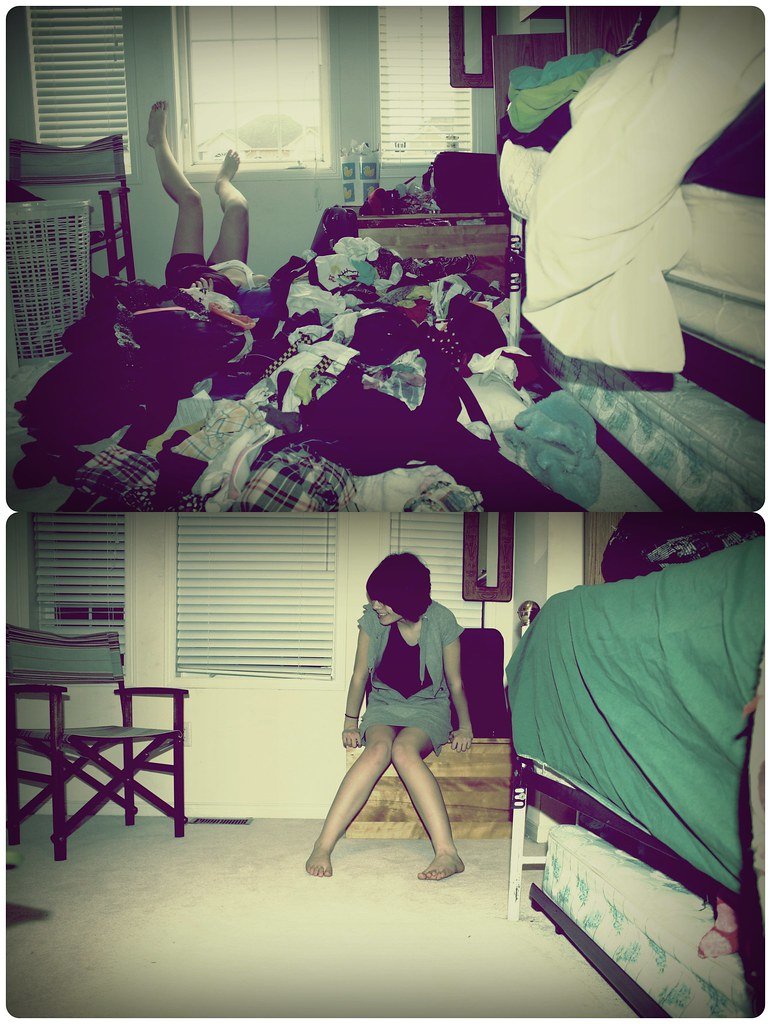
It is a single, small study, but it points at something many people already notice: a messy room is rarely neutral. What follows covers how the brain handles a crowded field of view, what disorganization tends to do over a day, and practical ways to cut it down without turning into a minimalist.
Why clutter weighs more than it seems
In 2011, Princeton neuroscientists Stephanie McMains and Sabine Kastner reported in the Journal of Neuroscience that when several objects are in view at once, they suppress each other’s neural responses across the visual cortex. This mutual competition is thought to reflect the brain’s limited capacity to process many things at the same time. Grouping items into an orderly shape reduced the competition, and focused attention could help counteract it.
That experiment had only ten participants and used simple on-screen shapes, not messy bedrooms, so it cannot prove that a pile of laundry costs you anything measurable. What it offers is a plausible mechanism for why a visually busy room can feel demanding: the brain is constantly sorting competing items even when you are not consciously looking at them. That is also why putting things behind a closed door or inside a container may feel like relief: fewer competing objects stay in view.
Effects of disorganization day to day
Day to day, disorganization tends to show up in a few recurring ways:
- A sense of mental overload: cluttered spaces tend to create a constant feeling of unfinished tasks.
- More time lost looking for things: items with no fixed spot increase the time spent on simple tasks.
- Harder to relax in the space: it’s harder to unwind in a visually busy room.
- Stress that builds over the day: small, repeated visual annoyances add up over time.
These are general, commonly observed effects, not a clinical claim — everyone reacts to their environment differently. Stress is also not caused by objects alone; how much a room bothers someone may depend on who lives there and what the items mean to them. A simple way to notice the second item is to pay attention for a week to how often something has to be hunted for, whether keys, a charger or a bill. If stress is persistent, the post on chronic stress covers the wider picture.
Ways to cut the clutter
You don’t need to renovate the house or become a minimalist overnight. Giving each category of item a fixed spot — using simple storage bins — already cuts down a lot on that constant feeling of clutter, without major changes. Choosing the busiest surface first, such as the desk, the entryway table or the kitchen counter, gives the quickest visible result. Open, stackable containers suit the categories used every day, because items can be found and returned in seconds, while rarely used things can go higher up or farther away.
Two habits make the effect last. One is a short daily reset, a few minutes to return items to their spots, so piles never get a chance to grow. The other is to deal with unfinished projects directly, since they were part of what the home-tour study counted as signs of a stressful home. Putting a half-finished task in one labeled box, or scheduling a time to finish it, is a small step toward that, and it turns an open-ended pile into a defined job.
What the home-tour study actually measured
The 2010 paper by Saxbe and Repetti, “No Place Like Home,” was published in Personality and Social Psychology Bulletin. Because the tours were self-guided, people chose what to point out, and their transcripts were analyzed with text-analysis software for four kinds of words: clutter, a sense that the home was unfinished, restful words and nature words. The first two were combined into a “stressful home” score and the last two into a “restorative home” score.
Over three weekdays after the tours, wives with higher stressful-home scores had flatter cortisol slopes, a pattern that has been linked to poorer health outcomes, and rising depressed mood over the day. The results held after accounting for marital satisfaction and neuroticism. The reported findings concern wives, so it would be a stretch to say they apply equally to everyone. A related read on mental load is the post on procrastination.
When mess becomes hoarding disorder
Ordinary clutter is different from hoarding disorder, a recognized condition. According to the American Psychiatric Association, it involves a lasting struggle to discard possessions because of a strong need to keep them, causing significant distress and clutter that fills living areas and limits how they can be used. About 2.6% of people are estimated to have it, more often those over 60 or with anxiety or depression, and it affects men and women about equally.
The difference is one of degree and impact. A busy desk or an overstuffed closet is a common annoyance. When possessions block the use of rooms, discarding causes real distress or safety is at risk, a doctor or mental health professional is the right person to ask, and asking is a reasonable first step. Collectors, by contrast, gather items around a theme and display them.
To keep exploring this subject, take a look at tap water.
Recommended product
Stackable Storage Bins Set — stackable, gives everything a fixed spot without using extra space.
Disclosure: this is our tracked Amazon affiliate link.
Want to actually fix this? Check out our full comparison: What’s the Best Robot Vacuum.
One storage bin on the entryway table is a small enough experiment for this week: if the room feels calmer by Friday, that is the first result that matters.